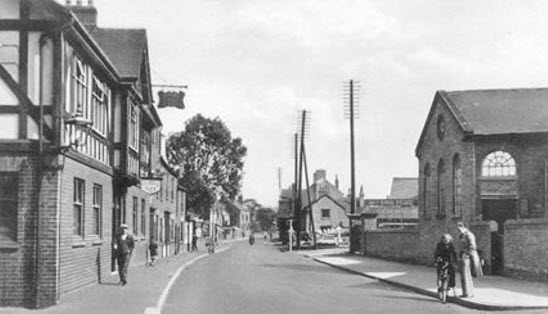
Stapleford Silk Mill
The Stapleford silk mill operated between May 1857 and April 1898 as a branch of a much larger mill in Beeston,{1] processing silk which was imported in skeins from its country of origin. The thread from the cocoons was too fine to be woven into cloth and needed to undergo a process known as 'throwing.' This entailed combining a number of threads together and twisting them to give the stronger thread needed for further knitting or weaving. The Beeston mill was erected in 1826 by William Lowe. It was destroyed by fire during the riots following the failure of the Reform Bill in 1831[2] but was rebuilt and was soon a significant employer of labour. William Lowe died in 1841 and left the mill to Frances Butcher Gill, a Nottingham silk and commission agent.[3] By 1851 Gill had taken into partnership John Watson,[4] who had been the co-executor of William Lowe's will.
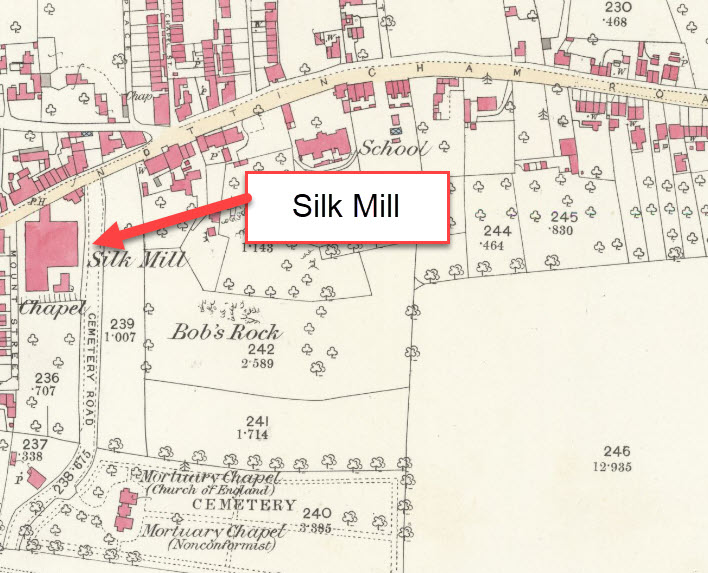
In May 1857 Gill purchased land in Stapleford for £391 17s. 6d. from John Draper Greasley, a Nottingham wine merchant. The mill was built fronting Nottingham Road, between Mount Road and Cemetery Road.[5] An advertisement for the sale of the premises by a later tenant, the Stapleford Vinegar Brewery, lists a dwelling house, a pump house, an extensive single-storey building with a ground floor space of 8,000 sq. ft, and many outbuildings.[6] In January 1868 a 50 per cent share in the business was transferred to John Watson, for which he paid £1,549 7s. 1d.[7]
In 1851 12 people in Stapleford worked in the silk trade,[8] indicating that even before the local mill began operating, a number were working in mills outside the parish. In 1861, four years after Gill had purchased the land in Stapleford, there were 66 men and women in the village working at the silk mill.[9] In 1871 the number had risen to 118.[10] By 1881 it had fallen to 69, many of whom were on half time,[11] and by 1891 there were only 11,[12] probably indicating that manufacture had ceased in Stapleford. These numbers included those who worked in mills elsewhere but excluded those who came in every morning from adjoining towns and villages. However, the majority who worked at the silk mill were local people. In 1871 for instance, the year of maximum employment, only nine people came from Sandiacre parish to work in the silk mill.[13]
Henry Chapman was the manager of the mill for most of its life. He was much respected in the village. Chapman was born in 1823 in Derby. In 1841 he was living in Devonshire Street, Derby, along with his mother Ann and brother Frederick, all of whom are described as silk throwsters.[14] In 1851 he was living with his wife Sarah in Chapel Street, Beeston, where he was an overlooker in a silk mill.[15] In 1861, 1871 and 1881 he was in Stapleford and returned as the manager of the silk mill.[16] In December 1881 he had a serious accident whilst trying to refit a strap on a wheel from which it had slipped. His arm was caught in the machinery and broken in three places and had to be amputated.[17] In 1885 he was living at 8 Healey Street in Nottingham working as a beer retailer and shopkeeper.[18] He remained there until 1900 when he moved to 54 St. Peter's Street, Radford, where he continued as a shopkeeper.[19] He died in 1900.[20]
Meanwhile Gill had retired in 1871 and moved to Somerset. He died in 1884 leaving an estate of £34,160.[21] Watson took over the sole ownership and operation of the mill when Gill retired. Watson died in November 1876 leaving an estate of between £50,000 and £60,000.[22] Following his death in 1876 his son Samuel Watson took over. By 1891 Samuel had begun to run into financial difficulties and the Stapleford site was sold in April 1898 to Edward Wheeler Field, a Nottingham brewer for £2,500.[23]
Footnotes
Click on footnote to return to main text.
- For which see the website 'Exploring Beeston's History', managed by David Hallam, with whose permission sections relating to Stapleford have been used here.
- Nottm Journal, 29 Oct. 1831.
- TNA, PROB 11/1949, f.51.
- Source; See 1 above.
- Notts. Archives, DD/AN/188.
- Derb. Advertiser, 3 Mar. 1911.
- Notts. Archives, DD/AN/189.
- TNA, HO 107/ 2141.
- TNA, RG 9/ 2491.
- TNA, RG 10/ 3554.
- TNA, RG 11/ 3391.
- TNA, RG 12/ 2725.
- TNA, RG 10/ 3555 & 3556.
- TNA, HO 107/199 12 4.
- TNA, HO 107/ 2127 5.
- TNA, RG 9/ 2491 62a. RG 10/ 3554 7. RG 11/ 3391 50.
- Notts. Guardian, 9 Dec.1881.
- Wright's Dir. Nottm (1885), 178.
- Kelly's Dir. Notts. (1900). 233.
- Nottm RD,1900 Q2.
- Cal. Grants (1884).
- Cal. Grants (1877).
- Notts. Archives, DD/AN/190; below, this section, for the vinegar brewery which later occupied the mill.