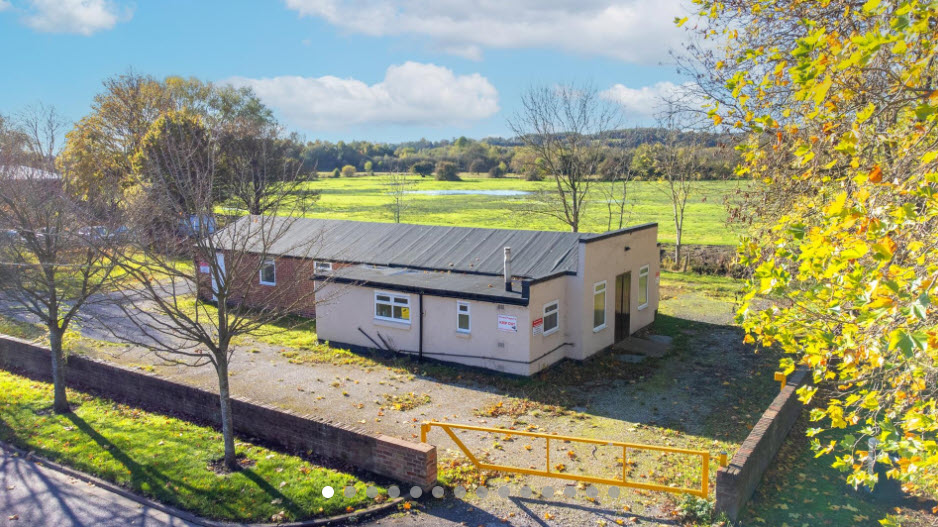
The Moorbridge Lane Social Centre
Early days: the new building. 1945-1951
The idea for the Moorbridge Lane Social Centre arose after the end of World War II when the fire fighting accessories that had been bought during the war by collecting twopence per week from Moorbridge Lane households were sold off for over £40. A meeting was held and it was decided to give £13 to the Moorbridge Lane Mission Church, 10s. each to local men returning from the Forces and spend the balance of £6 on a children's party.
The children's treat took the form of a 'field day' held in July, 1945 including a miniature railway, games and refreshments. When the finances were reckoned up it was found that instead of spending £6 on the event they had made a profit of and there was still more than £20 to dispose of.
Another meeting was called and it was then that the idea of a community centre and children's playground was born.[1] A committee was formed consisting of Secretary, Mr. T. Starbuck, treasurer, Mr. E. Thorpe, chairman, Mr. P. Wiggin together with Messrs. T. Ashby, F.Newton, W. Slaney, R. Wheat, J, Sibley, F. Green, F. Hawkins, E. Thorpe, junior, and Mesdames F. Slaney, F. Starbuck, P, Smedley, R. Ludlam and D. Church.
Tragedy struck the lane on the 21 June 1946 when Peter John Church, aged 10, of 162 Moorbridge Lane, and a class mate of mine, jumped into the river Erewash to rescue his friend, Terence Malcolm Whaley, aged 8, who had got into difficulties and couldn't swim.[2] Both boys were drowned and their death further encouraged the efforts of the Moorbridge Lane group to create a small recreation ground to give the children somewhere to play, other than by the river or canal.
Most of the unoccupied land on Moorbridge Lane was subject to flooding but undaunted, at the end of 1946, the committee bought an acre of land on New Road at the side of the Pastures Brook. A person, whose name is not known publicly lent them the money for the purchase, to be paid off over 25 years, [3] The site was subject to flooding and so tipping was invited. The committee worked long and hard to level the ground and bricks and rubble from old air raid shelters were a great help.[4] Finally, Stanton Ironworks, a large local employer for whom many of the committee worked, agreed to donate three thousand tons of basic slag and this raised the level by three feet, well clear of flooding.[5]
The committee then searched for a suitable building and one was found on National Coal Board property at Edwinstowe. It was a wooden hut, 60ft. by 19ft., and the committee bought it from the Ministry of Supply for £120. Ten men went to Edwinstowe at Whitsun 1949 and dismantled the hut and loaded it on to two lorries and brought it back and unloaded it at the site. The work of erection was put out to contract, undertaken by Mr. John Palmer, J.P., the chairman of Beeston and Stapleford Urban District Council, who had taken an active interest in the committee's scheme.[6]It was difficult to get permission to build and this delayed the additional work that was planned but this was finally obtained in July 1949.[7] A shortage of materials delayed matters further and it was not until 15 December 1951 that the centre was opened by Martin Redmayne, M.P. The original wooden hut had been lined with hardboard and a brick built kitchen and cloakrooms had been added. The floor was of pitchmastic. Mr. Stan Wood, with characteristic fervour, commented on the determination and grit that had helped the committee to win through in spite of many obstacles and said that ' 'It was probably the greatest thing that had happened to Stapleford for one hundred years, since the erection of the railway bridge in 1850.'
A new committee: the heart of the social life of the area. Decline. 1951-1971.
The centre having been set up, a new committee was appointed to run the organisation. Some of the members of the original committee, all of whom were made life members, were included. It consisted of President, Mr. Stanley Wood, a local politician; chairman, Mr. Philip Wiggins; secretary, Mr. Ernest Albert Starbuck; treasurer, Mr. Ernest Thorpe; Messrs. Thomas Ashby, William Slaney and Arthur Winfield, and Mesdames Frances Starbuck, Florence Slaney and Phyllis Smedley.
The hall quickly became the centre of social life in the area and was in great demand for wedding receptions. Annual General Meetings were held and financial statements published. The statement for the 18th months to June 20 1953 showed an income of £1,212 19s. 5d and expenditure of £1,104.8s.8d. with a balance in hand of £198.10s.0d.[8]
In July 1952 the centre, along with the Stapleford and Ryecroft Community Association, organised the 1st Annual Carnival Week[9]
The highlight of the year was the annual outing by train. The first outing planned was to Mablethorpe in 1948 when the fare was 16/-(80p). Subsequent destinations were Cleethorpes and Skegness. The journey to Cleethorpes in 1953 took just over three hours leaving Stanton Gate Station at 11.27.a.m. and arriving at 2.31p.m. The return journey did not leave Cleethorpes until 10.10. p.m., which must have been hard on those who started work at 7 a.m. the next morning. On the other hand the fare was only 12/-[10]
In July 1957 a new floor was laid and this enabled the centre to enlarge its activities. First on the list was a series of rock 'n' roll sessions for youngsters.[11]
In February 1955 the centre organised a visit to the Theatre Royal for old age pensioners and widows. For some it was the first time that they had seen a pantomime. Chocolates and sweets were provided by Mr. F Chambers, a Stapleford solicitor, who was keenly interested in the work of the organisation.[12]
The role of the hall as a centre for local social activity appears to have diminished over the years, although it continued to be used as a venue by outside organisations. The upkeep of the hall seems to have been fallen on to the shoulders of just a few people and there was little interest in the running of the organisation. No public annual general meetings were held after 1961, since in the previous four only the committee had turned up. No balance sheets were made public since there was no outside interest but the centre was sound financially and the committee kept the financial situation under review. In 1971 Mr. E A Starbuck, who had been secretary of the centre since the beginning, made an appeal for help. Ill health was making it increasingly difficult for him to look after the centre and he needed to hand over responsibility to someone else but when no help was forthcoming the matter was put into the hands of a solicitor to find a buyer.
Revival of activity: and decline. 1971-2022.
This threat to the existence of the centre galvanised local feeling and a new committee of 12 was appointed with a fresh approach and with fund raising events planned.[13]
In April 1980 Broxtowe Borough Council agreed to buy 1,750 sq. yards of the Centre's land, just over one third of the original plot, for £8,000.[14]
The hall underwent a major refurbishment in 1981 for which Broxtowe Borough Council gave a grant of £2,080. Further grants were made in 1982.[15]
The centre registered as a charity 4th December 1981. The register shows that the centre had no income for the year to 31st March 2022, having presumably ceased to operate. In 2022 there were three trustees.[16]
The building was being offered for sale with Robert Ellis, Stapleford, on the 8th November 2022 at a price of £250,000.
Footnotes
Please click on footnote to return to main taxt.
- Stapleford & Sandiacre News, 14 June 1947.
- Ibid.,29 June 1946.
- Ibid.,18 Feb. 1972.
- Ibid.,14 June 1947.
- Ibid.,13 Oct. 1951.
- Ibid.,13 Oct. 1951.
- Ibid.,30 July 1949.
- Ibid.,25 July 1953.
- Ibid.,17 May 1952.
- Ibid.,20 June 1953 and 29 May 1954.
- Ibid.,27 July 1957.
- Ibid.,26 Feb. 1955.
- Ibid.,28 Jan. 1972.
- Ibid.,10 Apr. 1980.
- Ibid.,23 Sep. 1982.
- Charity No. 511996