A Stapleford childhood
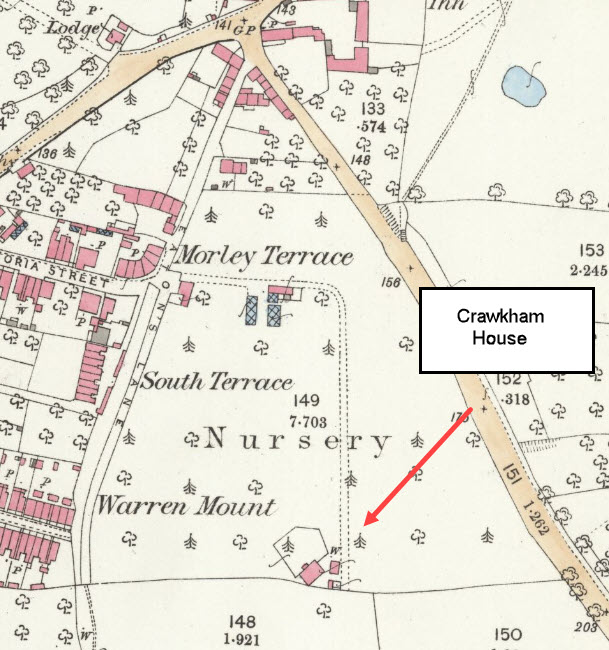
and Toton Lane, now Gibbons Avenue.
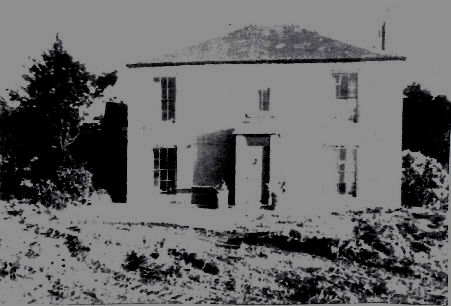
I was born in the White House, some nine months prior to the outbreak of the Second World War. The White House in question was a clapboard cottage in Headcorn, a small village east of the Medway in Kent - and that entitles me to be known as 'A man of Kent'. However, my time in the Garden of England was limited on account of the aspirations of Herr Hitler. My Mother amused my children by telling them that when the Luftwaffe were returning home after raids on London, they would target my pram with unused bombs. They missed! That aside, when a German invasion became a very real possibility, I was 'evacuated' to Mother's family home in Stapleford. Thus began my childhood at Crawkham.
My grandfather, Albert Gibbons, had died before my parents married, and the farm was run by my Aunty Milly, the eldest of his four daughters. She married Stanley Thomas, a solicitor, and lived in Briar Gate, Long Eaton. Sadly, Uncle Stanley died before his time and Milly returned to Crawkham. Aunty Alice was the other lady in my young life; the only daughter not to marry. In later years I surmised that her beau may well have perished in the Kaiser's War. Notwithstanding, a very independent woman who trained as a chiropodist and practised in Nottingham in partnership with a Miss Crosskill. The other daughter, Elsie, who was married to Eric Riley lived in Derby. Grandma (Lizzie) Gibbons presided over the household and my upbringing. Other nearby relatives included Nell Littlewood, Grandma's sister, who lived where the Twitchell from Eatons Road joined Brookhill Street. Her son, Uncle Harry, was a policeman - more of him later. Another couple I saw much of was Alice and Charlie Atkey were I believe very distantly related. Their home was in Mapperley. Uncle Charlie had the Austin agency in Nottingham and had a role in the Fire or ARP Service during the war. I always enjoyed going to see them, Charlie kept bees as a hobby and managed to convince me that I was an invaluable help to him!
To live on the Farm and follow each season with its attendant crops and cycles of activity was literally wonderful; as the pigs, hens, fruit and vegetables grew, I grew with them. It was my home, I was loved and although I did not know it at the time, I would re-connect seamlessly with almost forgotten parents one day in the future.
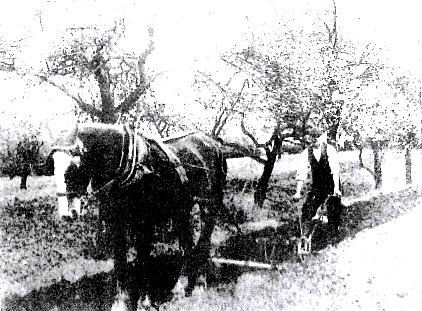
The real work at Crawkham was accomplished by an inseparable duo, Joe and Polly. Joe Rhodes could and did do everything on the farm and Polly was a shire horse of gigantic size. On Polly's vast back my little legs stuck out horizontally. But what fun it was to go with Joe to take Polly to be shod in Sandiacre. With so little traffic, we three could walk in perfect safety down to Derby Road, over the railway and the Erewash and finally the canal bridge and crossroads would take us to the forge in Town Street. On the return Joe would lift me on to Polly's back.
An additional treat would be to go to Nottingham market. As fruit and vegetables came into season, they would be harvested and boxed ready for sale. Polly would be harnessed between the shafts of the dray, and off we went. Sometimes I went to Market, but often Joe would drop me off at the recreation ground in Lenton and collect me on the run back to Stapleford.
Another man, Cook, helped on the farm. A wartime placement as he seemed too old for active service. When the apples, pears and plums ripened, the extra manpower needed was always forthcoming from a regular band of men living close by. All of them worked in local factories feeding in to the war effort, but once off-shift would come and pick fruit, the only name I can recall is that of Maurice Dakin. By the farm gate there was a warehouse, used partly to stack produce for onward transmittal, and by the door, whatever was in season for sale to the general public. Mornings only, and all the local housewives would come for their fresh (still got soil on) veg, fruit and eggs. At the more heroic end, five tons of rhubarb at a time would go to the jam factories - the carrier was Mr Curnow, he used to let me pretend to drive his lorry.
Two of my most prized possessions were a second-hand red tricycle, which I would ride at high speed from the house, down the slope of the cartway to the gate. Sometimes I didn't fall off. The other was a very splendid wheelbarrow, made by Duke Atkin and scaled down to my size. Mr Atkin was a carpenter in the employ of the Co-op and had a workshop at the end of Northwood Street. A very gentle-man as I recall. Another person I saw on the farm was Harold Turland. Mr Turland had an allotment between the cartway and Toton Lane and a small shed for his tools. He would tell me what he was about when I saw him and I have often mused since about the co-existence of such large and small scale productivity.
Just beyond the gate, at the top of Victoria Street, was the house, yard and store of J Topps and Son, painters and decorators. I always enjoyed going there and loved the smell of paint and turpentine. One of the boys, Donald, although older than me, would frequently come to the farm and we would play together. He would tell me about the Boy Scouts, which led eventually to my becoming a Wolf Cub. Later in our lives, he a Structural Engineer and I an Architect, we worked together on a project on Teesside. Sadly, he died following heart surgery in the early 70s. To the other side of the gate was a row of terraced houses, in the one nearest lived Elsie Brooks. Mrs Brooks came most mornings to help Grandma and many a time I would go back home with her. We would chatter away, she spoke of her husband Ernie who worked in a factory and liked to go to 'the match' on a Saturday afternoon - I had no idea what a match was other than something to light the fire with! When a little older, a school friend lived in the same road as Tommy Lawton when he played for Notts County. All was then made clear, but I still did not know which of the Nottingham/Derby teams Ernie supported. Mrs Brooks was kind but firm, if I erred I was scolded and her ultimate sanction would be to "tell a policeman". This generally had the desired effect, but also one of puzzlement. Uncle Harry officially represented the Law, but I only saw him off-duty when he would come up to the farm and take me ratting. With pigs, poultry and other food a-plenty, rats thrived. Uncle Harry and his ferrets, together with my puny efforts to stop up some of the holes restored the balance. Uncle Harry would surely not commit me to a prison cell?
Entertainment as such was wholly self-generated. In winter evenings I was encouraged to draw. Once taught, I read avidly, my Aunts had some old Chatterbox Annuals which I went to time and again, I was fascinated by the illustrations - all engraved. Rupert Bear Annuals at Christmas were looked forward to. We played cards, beginning with Snap, which was very noisy. I eventually became quite good at Pontoon which was played using a bag of pre-war Co-op tokens instead of money. My Aunts would often have bridge parties of an evening, in later life I learned that Aunty Milly played bridge at County level. The first time I was taken to the cinema was to see 'Snow White and the Seven Dwarfs' at the 'Palace', which was effectively the last building in Stapleford before crossing the County boundary into Sandiacre. I was hugely excited by the whole experience, but absolutely terrified by the wicked witch. During summer weekends we might go to the Hemlock Stone, have a picnic somewhere or walk over to the Trent at Toton and take the ferry to the far bank - the ferry was a large rowing boat. The walk back always included a stop at the Cosy Café.
Winter snow, for children at any rate, was a welcome diversion. Snowmen, snowfights and sledging. I could sledge down the cartway, but slowly since the gradient had to allow for Polly pulling the dray either way. The best place to go was Stony Clouds, there were three runs as I remember it, big hill, little hill and electric shock. The last ran from the big to little hill over a line of frozen tractor tracks… When I became old enough I joined a Cub Pack, Miss Meads was Akela. We had a great time, the best outside where we would learn about tracking and natural history. We went to different places, developed useful skills and even at our young age made the promise to 'Do my duty to God and the King and help other people'. One evening I was running late, we were to meet at Bramcote Hills, so I asked Aunty Alice to take me in the car, a very pre-war Austin Seven. On urging greater speed, I was put down very firmly with "I am already doing 40 miles per hour".
People that I recall were an interesting variety, but reflected the place from my own perspective. Willy Farr who lived in Eatons Road, he worked on the railway, had perfect manners and a joy to speak with. I played with Neville Morley, his Dad was amazing with model aeroplanes and lived in Alexandra Street. Mr Baggs was vicar at St Helens, I was at school with his son Michael. Mr Hammond was minister at the Baptist Church - I went to Sunday School there (morning and afternoon) since a neighbour who taught there took me. An adoptive Uncle, Frank Harrison, was an auditor with an office on Nottingham Road. He was something of a pioneer motorist and did a deal of 'route recording' for the AA. Splendid fellows with motorcycle and sidecar who always saluted members. Dr Vartan, long retired, but he took time and trouble to tell me much about old Stapleford. Dr Sherowit had a practice this side of the canal in Sandiacre, he played bridge with my Aunts and was our pre- NHS doctor. Telling me I had to have my tonsils removed, I asked when. "Two weeks time" was his reply, at which I relaxed. That was so far ahead there was no need to worry. Another medical connection was with Dr Boyd, a mild mannered Scot who frequently took me to school with his son Gavin. He was of course one of a minority who could run a car during the War. Also, my gratitude to an unknown train-driver at Nottingham Victoria Station, he took me up onto the footplate of the engine when seeing off Father off after one of his few visits.
The actuality of war did not impact on my consciousness very much. The abnormalities of wartime were my normalities, that was how life was. The proximity of Chilwell Depot, the vast Toton Railway Sidings and Rolls Royce in Derby ensured nights in the Anderson Shelter every now and then. It was located in a copse in Polly's field and at the time seemed quite an adventure. Later on, the still air of summer mornings would be punctuated with the sound of aero-engines being tested. Perhaps the most poignant memory was that of Grandma taking to putting a shot of gin in her afternoon tea. That recollection I solved many years later. What I did not know at the time was that Father, as Flight Engineer in a Lancaster, had been shot down bombing German supply lines south of Paris the night after D Day. The crew were all 'Missing presumed killed'. Quite naturally, Grandma needed a bracer. Some three months later a telegram was delivered to Crawkham. Not by the Telegraph Boy, but by the Postmaster himself. Mr Annis brought news of Father's safe return to England.
Although the serious shopping was done at Griffin and Spalding in Nottingham or The Midland Drapery in Derby, I was in and out of many of the small shops in Stapleford. Albert's grocery shop in Church Street was stocked with tins floor to ceiling and he had a delivery-boy, who looked about 90, who took orders out on a two wheeled trolley. Miss Cooper sold sweets from a shop near the Beer-Off in Victoria Street, she enjoyed my patronage. Mrs Hall's Ironmongery at The Roach was useful for odds and ends for the farm. There was a Newsagency near the traffic lights, I would go there to collect the Beano and Dandy each week. Mr Dable had a Butcher's Shop at the top of the hill towards Bramcote - I heard he committed suicide, but that sort of thing was not discussed with children. The Cycle Shop run by Mr Hooley was brilliant. He rebuilt my first full sized Raleigh bike, it looked like new by the time he finished it. Towards the far end of Church Street Mr Bassett had a cobbling business in the front room of his house - it seemed that he could repair anything with leather. The Post Office was in Derby Road and close by Boots the Chemist managed by the redoubtable Mr Winstanley.
My formal education began with Mrs Ripley, in a school-room next to the garage in her back garden. The house was on the corner of Nottingham Road and Ewe Lamb Lane, the latter no more than a dirt track in those days. There must have been twenty or so pupils. We each had little blackboards and chalk and so began a basic tuition in the 3 Rs. Almost Victorian in concept, Mrs Ripley taught and the older pupils helped the younger ones. I vividly remember reading a story about a pig to Delia Bennett who patiently helped and corrected me. My less academic claim to fame was when I was learning to ride another child's 'fairy cycle'. I eliminated one of Mr Ripley's blackcurrant bushes. Aged six, I went on to Greenholme School which I believe is still in existence on the Lenton side of Nottingham. It was a 5d. return Barton bus ride each day. If I went to the stop outside Bancroft's Garage, I would occasionally miss the bus because I had become totally absorbed watching the mechanics. Cue for Headmistress to tell me off; Mrs Dewsall-Skeggs did not take prisoners, she was fearsome in the extreme and ran the place with a rod of iron. She told me she knew my Aunt and would be communicating my transgressions. Young as I was, I had serious doubts about Aunty Alice's choice of friends. Notwithstanding, the teachers, all ladies, were kind and capable. In the summer, lessons on the lawn made a welcome change from the classroom. We used an adjacent playing field, my attainments on Sports Day were generally better than the results on my report. Two years later several of us went as boarders to Bramcote Hall, sadly now demolished. After that, five years at Trent College completed my schooldays.
It was indeed a full and happy childhood in a truly wonderful community - I Iook back on it fondly. Never mind the cold bedrooms, the kitchen range on a winter's morning made up for it. It was touching that many I had known were kind enough to send me cards on my majority even though I had moved away. The family had re-grouped after the war ended. Father concentrated on pig breeding at Crawkham for a few years, but returned to the RAF when Crawkham was acquired for a school and housing. Home then was wherever he was posted. I have in my own home an antique long-case clock that was in the drawing room at Crawkham, which is a constant reminder of such good days at such a bad time in our Island's history.
Stuart Archie Russell
Biggleswade,
Bedfordshire December 2016