Springfield Cycle Co
Introduction
The Springfield Cycle Co manufactured cycles in Sandiacre and Stapleford between 1895 and 1900.
The company was incorporated in 1895[1] and in December of that year it advertised in the Manchester Courier for a 'Lady Clerk, able to speak and correspond in French and German; typewriting a recommendation. ' A clear indication that the company had its eye on the export market. [2] In March 1896 further advertisements appeared in Leeds and Sheffield newspapers wanting 50 men for the cycle trade, listing a full range of the specialities.[3] The company at first operated in the Springfield Mill but later moved across the road to a purpose-built factory,
People involved in the company.
The chairman of the company was Terah Hooley[4] the local entrepreneur and the owner and builder of the Springfield Mills. He was the father of Ernest Terah Hooley, well known financial fraudster.
Two of the pioneers of the cycle trade were associated with the Springfield Cycle Co. Early cycles were known as 'velocipedes ' or 'bone-shakers ' and were produced in the 1860s. These were followed in the 1870s by the 'high wheel 'or 'penny farthings. ' In 1885 the first successful 'safety ' cycle, so called because the rider was no longer seated high in the air, was produced with a steerable front wheel, equal size wheels and a chain drive to the rear wheel. The diamond frame soon established itself as the industry standard and Dunlop pneumatic tyres completed a vehicle for the masses.
In Nottingham there were a number of cycle makers , among them Richard Morris Woodhead and Paul Eugene Louis Abngois.[5] Woodhead was born in 1842 in Edwinstowe and Angois at Pierre-les-Calais(Pas-de-Calais) c.1853.[6] Both were engineering fitters and in 1885 entered into partnership as a bicycle repair shop in Raleigh Street, Nottingham. They began to manufacture cycles themselves and in 1886 were joined by William Ellis who provided additional finance. In 1887 they established the Raleigh Cycle Co. on Russell Street, which was incorporated two years later.[7] In Autumn 1888 Frank Bowden, impressed by the quality of their product, paid a visit to the company and persuaded them to allow him to back the company. Ellis was bought out and after a further company incorporation[8] Bowden acquired a controlling interest. In October 1894, after Bowden accused Woodhead and Angois of management incompetence, both resigned leaving Bowden in sole charge. In 1895 Woodhead was appointed manager of the Springfield Cycle Co. in Sandiacre and was responsible for equipping the factory, using machine tools made by Alfred Herbert of Coventry.[9] In a possible link with the Sandiacre Screw Co., after the closure of the Springfield Cycle Co., Woodhead formed the Woodhead Manufacturing Co. based in Sandiacre.[10] In 1901 they were advertising for nut and screw forgers using the treadle based Olivers.[11] Woodhead, then of 583 Mansfield Road, Nottingham died in December 1901[12] leaving effects valued at £10,854. Paul Angois, who was one of Woodhead's executors,[13] died in 1938, when he let £12,346.[14]
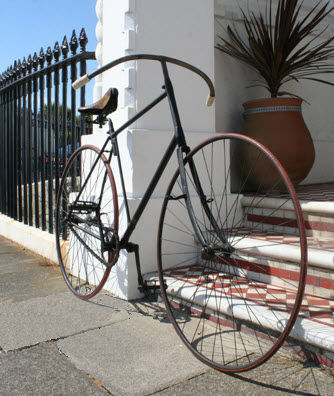
The second pioneer associated with the company was Sydney Dawson Begbie (Syd to his friends in the cycling fraternity.) He was born in London in 1865. He founded the firm of Begbie, Twentyman and Co which made the Hadley cycle in Kentish Town (Middlesex) but was better known as a racing cyclist. He was a member of the North Road Club and held a number of world road racing records. His name appears in the annals of the Road Record Association for 1890, along with P.E.Driver, as the holder of the 100 miles Tandem Tricycle solid tyre record with a time of 6hr 15min 16sec. These times were constantly being broken as machines were improved and road surfaces became smoother. In 1894 he claimed the record for the 50 miles tandem tricycle road race of 2 h. 16m. 50s.[15] In 1895 he took part in a twenty mile inter club track race but retired during the race 'completely baked ' and is never recorded as racing again.[16] The partnership of Begbie, Twentyman and Co, was dissolved in 1894 and in 1895 he was appointed as managing director of the Springfield Cycle Co. He resigned in 1899 and spent the rest of his business life in various prominent positions in the motor trade. He was living at Lee on the Solent (Hants.) at the time of his death in 1947, leaving effects valued at £45,489.[17]

The cycles
The cycles that Springfield made were sold under the brand name 'Valkeyrie. ' [18] Wagner 's opera, Die Walkürie, was first performed in 1870 and the opening of Act 3 features the 'Ride of the Valkeyrie' as they ride into battle on their flying horses-symbolism which would not have been lost on the purchasers of the Sandiacre product. The cycles were of high quality and were of particular interest to racing enthusiasts and those who liked speed. 'The machines were extraordinarily light yet combined with that lightness a strength truly remarkable. ' [19] Their advertisements informed intending buyers that they were 'High Grade only, ' Some said that they were the 'highest grade cycle in the world ' and from 'Mr Hooley's big factory '. In March 1897 the 'Valkyrie ' was described as the fastest machine built. [20]
The company
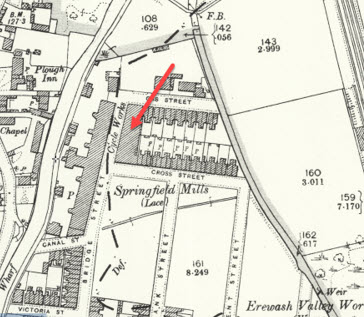
Unfortunately, it seemed that the emphasis on quality and speed did not make for a viable company. In August 1896 a meeting of members chaired by Terah Hooley agreed that the company be voluntarily wound up and that Sydney Dawson Begbie be appointed as liquidator.[21] A new company of the same name was incorporated in 1896[22] and moved the business from Springfield Mills across the road into Stapleford to occupy a purposed built factory of 1687 sq.yards, built by George Bastable, fronting Bridge Street, Cross Street and Gas Street.[23] In the summer of 1898 there was a nationwide advertising campaign making use of a network of agents.
The company was also involved in industrial espionage.[24] They employed in their offices Charles W. Edwards. He had been a book keeper with Raleigh, their rivals, who had noticed that when he left certain documents were missing, in particular their plans for the future and some designs for proposed new models. They obtained a search warrant and found copies of these documents in Mr. Edwards ' desk at Springfield-the originals having been smuggled back to Raleigh. The case came to court and Springfield claimed that they knew nothing about it. Counsel for the defendant said that Edwards was merely acting to further his career, although admitted that perhaps he had been indiscreet. The Bench were not convinced and sentenced Edwards to three months hard labour. It is to be hoped that Springfield were appreciative of his loyalty when he came back to work.
The company did not prosper and on the 30th June 1900 Begbie called a meeting of the company to lay before them an account of his winding up.[25] Auctions and company meetings followed but there is no indication of the outcome. Notice of the auction of the factory building was given for June 1901[26] and the machinery and equipment for October 1901. [27]Earlier In that month it was resolved to wind up the company and T G Mellors, chartered accountant, was appointed as liquidator.[28] Mellors gave an account of his winding up in October 1902.[29] The company was, reportedly, sold to Humber Cycle co. in 1899 but this has not been verified.[30]
Motor car manufacturing
In a last-ditch attempt to save the company, or perhaps a symptom of its problem, Springfield also produced a motor car, the Valkyrie Voiturette. It was fitted with a 34-h.p. De Dion water cooled engine, electric ignition and Dunlop pneumatic tyres. A photograph appears in the Motor Car Journal for 1901.[31] This was advertised for sale in June 1901, along with a Baby Renault Voiturette. [32] There was no indication of the asking price. If anyone still has this under a dustsheet in their garage, please let us know so that we can take a better photograph.

© British Library Board The Motor Car Journal 29 December 1900 page 734 LOU.LON 396 1900.
Footnotes
Click on footnote to return to main text.
- TNA, BT 31/6292/44537.
- Manchester Courier & Lancashire General Advertiser, 2 December 1895.
- Leeds Mercury, 17 Feb. 1896.
- London Gazette, 22 Sep. 1896 p.5285.
- Grace 's Guide. Except where indicated the information is obtained from Grace 's Guide to British Industrial History and widely available articles on Raleigh cycles and cycles in general.
- TNA, HO 334/30/11454.
- TNA, BT 31/4320/28604.
- TNA, BT 31/5218/35386.
- Harrison, 'Growth, Entrepreneurship and Capital Formation ', 269; Cycle Manufacturer 9 Nov. 1895, 172; 16 Nov. 1895, 184.
- TNA, BT 31/7242/5/1209
- Sheffield Daily Telegraph, 6 Mar. 1901.
- Death Index. 1901 Q4. Nottingham.
- Cal. Grants (1902).
- Ibid.(1938)
- Morning Post, 13 Oct. 1894.
- Gravesend Reporter, North Kent & South Essex Advertiser, 3 Aug. 1895.
- Cal.Grants (1947).
- Penny Illustrated Paper, 8 Jan. 1898.
- Belfast News-letter Belfast News-letter 26 Jan. 1898.
- Derry Journal, 24 Mar. 1897.
- London Gazette, 22 Sep. 1896 p.5285.
- TNA, BT 31/7073/49827.
- Notts.Archives DC/ST/3/1/1.
- Lincolnshire Chronicle, 17 Jan. 1896.
- London Gazette, 22 May 1900 p.3280.
- Derbyshire Advertiser, 14 June 1901.
- Nottingham Journal, 18 Oct. 1901.
- London Gazette, 22 Oct. 1901 p.6871.
- London Gazette, 30 Sep. 1902.
- Sandiacre Canal Side & Cloud Side Conservation Areas-character appraisal. Erewash Borough Council p.12 para. 3.36.
- The Motor Car Journal, Vol.2 p.734.
- Nottingham Journal, 8 June 1901.