Stapleford Vinegar Brewery
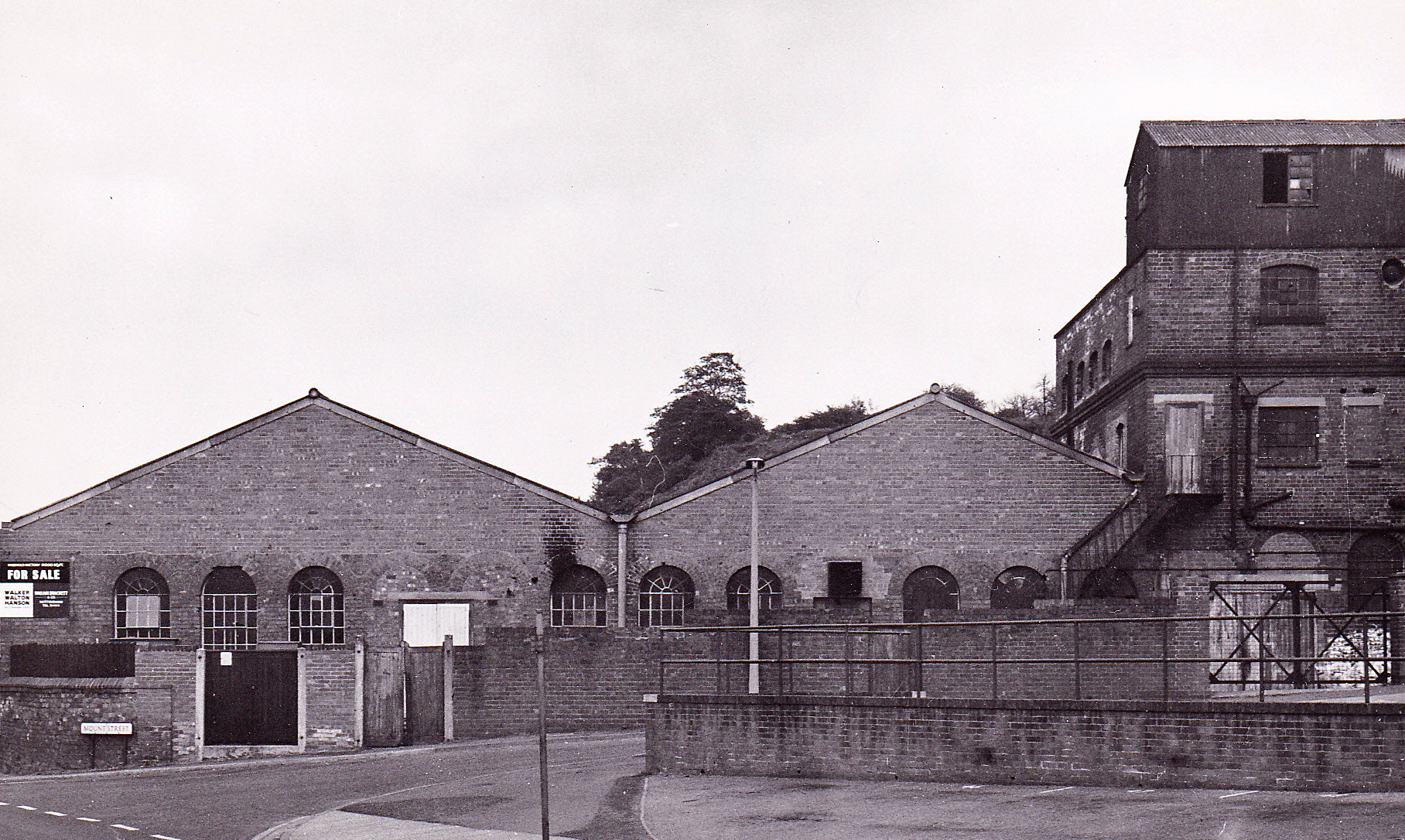
The Stapleford vinegar brewery operated from premises on Nottingham Road between the junctions with Cemetery Road and Mount Street, formerly occupied by a silk mill,[1] between 1898 and 1910, selling Royal Malt Vinegar. Beer and vinegar production both start with malted barley which is processed in a vessel along with water converting the starch to sugars. The liquid, the wort, is extracted and used to brew beer by adding yeast and hops. It is also used to produce vinegar by adding yeast and allowing it to ferment, after which acetic acid bacteria in the form of the 'vinegar mother' is added. The mixture is allowed to ferment for five weeks and the ensuing liquid drawn off as vinegar.
The former silk mill was sold in April 1898 to Edward Wheeler Field, a Nottingham brewer, for £2,500.[2] Field was born in St Pancras, London, in September 1837. His father, also Edward Wheeler Field, was a licensed victualler in Tottenham Court Road.[3] In 1872 Field married Rosetta Johanna Neal at Winslow (Bucks.).4 The couple had two children, Edward and Frances Wheeler Field, born in 1874 and 1878 at Douai (Nord).[5] Edward was to become the manager of the vinegar brewery. Frances was married twice, first in 1903 to Robert Henry Byles, a consulting mining engineer (1860-1911),[6] and second in 1913 to Prof. William Robert Smith (1850-1932), a physician.[7] The second marriage took place at St Margaret's, Westminster, and was conducted by the bishop of London.[8] Smith was also active in City politics. He served as Sheriff of London in 1918 and was knighted in 1919.[9]
In 1879 E.W. Field senior bought the Nottingham Brewery and in the 1880s and 1890s the family lived on the premises at Melbourne Street in St Ann's, Nottingham.[10] By 1900 they had moved to Cloud House, Sandiacre.[11] On occasions their address was given as Aspley Hall (in Radford).[12] The Nottingham Brewery was founded in 1847 on Mansfield Road. The brewery had extensive cellars in the sandstone which were ideal for maturing the cask ales.[13] Under Field's ownership, trade increased twenty-fold and the brewery controlled about 180 pubs. In 1892 and 1894 the company won gold medals for the excellence of its beer from Paris and Antwerp.[14]
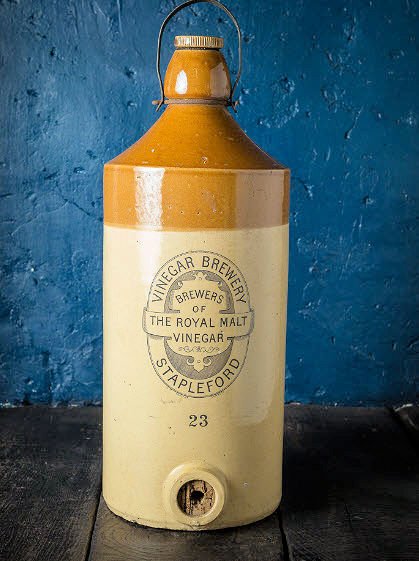
The vinegar business was incorporated in 1900 as the Stapleford Vinegar Brewery Ltd, with an authorised capital of £20,000 in £10 shares. Field became managing director, and the other directors were Philip Austin Birkin of Bestwood Lodge, Bestwood, a brewer and partner in the Scarsdale Brewery in Chesterfield (Derb.),[15] and Richard Challands of The Park, Nottingham, a retired lace manufacturer.[16]
Details of the vinegar brewing process were given in a lecture by H. C. A. Vine to the Institute of Brewers, Midland Counties section, in 1911.1[17] Vine was an applied chemist and microbiologist who specialised in the brewing industry and appears to have been a consultant at Stapleford. He reported that the brewery used the quick Orleans process, in which acetification was carried on in a large number of horizontal casks each of about 150 gallons capacity and each making about 36 gallons of vinegar at every operation. They were worked in a closed room equipped with the means of maintaining a suitable temperature. In place of the wash being pumped over, the casks were themselves rotated slowly by power at intervals which varied according to the extent to which the process had progressed and the temperature. This acetifying plant, although very convenient, clean and reliable, required very careful and skilled attention, and it was essential for economical production that the whole of the acetifiers should be kept in line, so that all were ready for discharging simultaneously.
The 'careful and skilled attention' was entrusted to Field's son Edward, who in 1901 was living at the brewery house in Stapleford.[18] Edward was educated at Harrow School, University College, Nottingham, and Edinburgh University, where it was intended that he would continue his business education.[19] By 1910 the company must have been experiencing financial problems because the mortgagees foreclosed on its assets.[20] The equipment was put up for auction in January 1911 and the premises two months later.[21] The company was struck off in October 1916.[22]
In 1895 Edward Field married in secret Frances Annie Platts, a farmer's daughter from Trowell. They separated at the register office door and neither had told their parents. She urged him to go to Edinburgh, make the marriage known and take her with him, but he made excuses. She subsequently discovered, according to her petition for divorce in 1908, that between 1896 and 1906 he had committed adultery with numerous women. Field did not appear at the hearing and the marriage was dissolved with costs of £65 10s. 1d awarded to the petitioner.[23] In 1911 Field was lodging in a boarding house in Hackney.[24] In 1930, aged 56, he married Annie Maria Wheeler, the widow of Thomas Bertie Wheeler and the daughter of Guest Luckett, an Aylesbury architect.[25] Field died in 1934 at 41 Redcliffe Square, South Kensington. His obituary gives no indication as to what happened to him after the brewery closed down, although mention is made of his father, his sister and his father-in-law.[26]
Footnotes
Click on fotnote to return to main text
- Stapleford Silk Mill.
- Notts. Archives, DD/AN/190.
- St Pancras baptism register (1837), p. 252.
- Winslow RD 1872 Q2.
- TNA, RG 11/3353/63.
- Trans. Inst. Mining and Metallurgy (1911-12), 721.
- British Medical Journal (1932), 592-3.
- Northern Whig, 23 April 1913.
- The Scotsman, 30 July 1919.
- TNA, RG 11/3353/63, RG 12/2693/31.
- Kelly's Dir. Notts. (1900), 147
- Nottm Journal, 8 March 1888.
- A. Barnard, The Noted Breweries of Great Britain and Ireland (1889-91), III, 374.
- Brewers' Guardian, 8 Nov. 1892, 327.
- J. Hirst, Chesterfield Breweries (Author, nd), 25-30.
- Nottm Evg News, 10 Jan. 1900; BT 31/8819/64700.
- H.C.A Vine, 'Some points of Interest to ale brewers in the vinegar brewer's mash-tun', Journal of the Institute of Brewing, 17 (1911), 322.
- TNA, RG 13/3211/43
- Bucks. Herald, 26 Jan. 1934.
- Derb. Advertiser, 3 Dec. 1910, 3 March 1911.
- Ibid., 3 Mar. 1911, 000 Dec. 1910.
- London Gaz., 3 March 1911, 24 Oct. 1916.
- TNA, J 77/938/8491.
- TNA, RG 14/1092/303.
- Kensington RD, 1930 Q3; Bucks. Herald, 26 Jan. 1934.
- Bucks. Herald, 26 Jan. 1934; there was no grant of probate or administration.