Telephone
The telegraph.
Stapleford has been in touch with the outside world by electrical means since 1870.[1] The electric telegraph was developed in the 1830s and a network of lines quickly covered the country based on the railway. The system was nationalised in 1870 and it was the policy of the Post Office to extend telegraph facilities to all the post offices from which money orders could be sent. The network was therefore extended to town centres and in the 1871 census, we find that William Fletcher was the receiver of the post in Stapleford and his daughter, Elizabeth, aged 19, was the telegraph clerk. Messages were sent by telegram and when the form was handed over at the post office the telegraph clerk would tap the morse code equivalent and transmit the message to the post office nearest to the recipient. The charge was based on the number of letters in the message, and this included the name and address. There were many different kinds of apparatus and it is not known which one was used in Stapleford. Morse keys (for sending) and sounders (for receiving); needle apparatus; Wheatstone perforators where punched paper tape was used to send the information, transmitters (for sending) and inkers (for receiving); Hughes printing telegraph, Wheatstone ABC and others were all in use. In fact, it wasn’t until the 1930s that the Post Office reached the point where it could standardise on the teleprinter across all lines. A good operator using a morse key could average 25 words a minute.
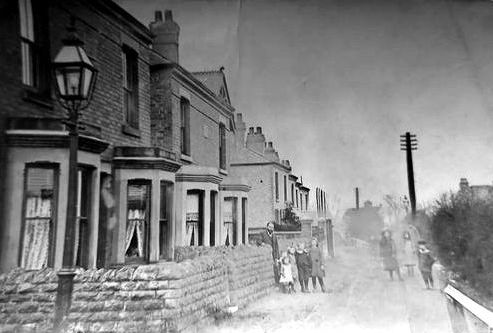
The telegraph posts can be seen on this photograph of Mill Road in about 1903. In other photographs taken from near the mill looking towards the Long Bridge the lines can be seen going across the fields to join up with the country wide network based on the railway.
The telephone 1885-1910
A natural development of the telegraph was the telephone. It was invented in America and was demonstrated to Queen Victoria in January 1878. A number of private companies began to build telephone exchanges and amongst them was the National Telephone Company, formed in March 1881 to exploit the market in Scotland and the Midlands. Some of its early directories have been uploaded on to Ancestry and the 1885 edition for Nottingham and District lists a number of subscribers in Long Eaton, Ilkeston and Trowell. The most notable is Joseph Orchard of Long Eaton who has the number 160A
By 1891-92 there are separate sections for Long Eaton and Ilkeston. The seven subscribers in Long Eaton have three-digit numbers starting with 6 and include Joseph Orchard with 648 and Joseph Fearfield with 606, Stapleford’s first subscriber. The 1895 directory reveals that there are now separate exchanges for Ilkeston and Long Eaton, both with 23 subscribers. The original numbers have now been prefixed by 1 and J P Fearfield is now 1606 and Whiteley Stevens and Co is 1619.
Demand for the telephone continued to grow and in the 1896 directory, the Long Eaton exchange has 30 subscribers, of whom 6 are in Stapleford and Sandiacre. Their names are:-
| Number | Name | Exchange | |
|---|---|---|---|
| 1625 | Henry Dobbs Lace Manufacturer | Sandiacre | |
| 1606 | J P Fearfield (Exors) Lace Manufacturer | Stapleford | |
| 1611 | Pratt, Hurst & Co Ltd Lace Manufacturers | Sandiacre | |
| 1631 | Springfield Cycle Co. Ltd The Cycle Manufacturers | Sandiacre | |
| 1610 | Walker J B & Co Lace manufacturers | Sandiacre | |
| 1619 | Whiteley Stevens and Co Lace manufacturers | Stapleford | |
The 16 was removed by 1899-1900 and so Whiteley Stevens, for example, became Long Eaton 19.
1910-1929
The next major change came in 1910 when, for the first time, Stapleford and Sandiacre had their own exchange.[2] It was housed in a house at 8 King Edward Street, Sandiacrte, leased from William Wootton at a rent of £19.10.0 per annum. The subscribers in Stapleford and Sandiacre had their Long Eaton numbers retained and just changed Long Eaton to Sandiacre. Fearfield became Sandiacre 6 and Whiteley Stevens became Sandiacre 19. This, of course, left gaps in the sequence and the Erewash Valley Golf Club were able to pick up Sandiacre 1, which they held until 1939. There were 39 subscribers in 1911. The licence of the National Telephone Co. issued in 1881 contained a clause giving the Post Office power to purchase the company after 30 years. In 1911 the Post Office exercised this option and the National Telephone co. went into liquidation. Henceforth the telephone directories were issued by the Post Office. The expansion of the telephone network was quite slow. In 1921 there were 57 subscribers, an increase of only 18 in 10 years.1929-1939
In 1929 an Automatic Exchange had been installed in Nottingham and their subscribers no longer had to call the operator to make local calls. It was to be a further 10 years before Sandiacre had its own automatic exchange in 1939 when the Long Eaton Advertiser on the 4th August commented that the new dial phones had been installed at their customers’ premises but still couldn’t be used because the exchange was not yet in operation. I remember visiting the exchange on Derby Road, still there next to the Tile Warehouse, with the Scouts one evening and being fascinated as the selector switches clicked up and down in response to the number being dialled by subscribers. The 1933 directory shows the area covered by Nottingham. It stretched from Barnsley in the north to Market Harborough in the south and from Stoke on Trent in the west to Mablethorpe in the east. Some examples of the charges for 3 mins at peak times-with 2019 values in brackets-were Derby 3d (90p), Birmingham 1s.6d, (£5.25), London 3s.(£10.50) and Glasgow 4s.(£14). Rates decreased in the afternoon and then again in the evening, e.g. the London rate went down from 3s. in the morning to 2s.9d. in the afternoon and 1s.6d. in the evening. Small wonder that they ran an advert “Ring your chix after six.” You could make a personal call for an extra 6d and if the person was not available you only paid the special fee. If you made the call from a public phone box the pips would sound a few seconds before the end of your three minutes and there would be a frantic search for more coins before you were cut off. These boxes had two buttons-Button A and Button B. You put coins in the slot and dialled the number. When it was answered, or you were connected by the operator in the case of a trunk call, you pressed Button A and went ahead. If there was no reply you pressed Button B and your money was returned. No schoolboy would pass a phone box without pressing Button B in case someone had forgotten to take their refund. It was not unknown for pieces of rag to be stuffed up the refund chute on the way to school and removed on the way home, hopefully releasing coins. As part and parcel of the new technology, all the numbers on the Sandiacre Exchange were changed to 4 digits. The method was to prefix three-digit numbers with 2 or 3, and to prefix two-digit numbers with 21,22,23,31,32 or 33 as needed to find them a vacant place in the sequence. There were already old three-figure numbers starting with 1,2 and 3 in use and these had to be avoided when selecting a prefix for the two-digit numbers. Effort was made to preserve the old number in some way, e.g. the Erewash Valley Golf Club changed from Sandiacre 1 to Sandiacre 2101. Some subscribers changed to more memorable numbers. Fearfield changed from Sandiacre 6 to Sandiacre 3366, the Fire Station changed from Sandiacre 81 to Sandiacre 2222 and the Vicar was changed from Sandiacre 199 to Sandiacre 3333. Perhaps the person doing the change was a member of his congregation and thought that the 3 of the Trinity would be well suited to a man of the cloth. Crossley-Premier Engines Ltd went from Sandiacre 138 to Sandiacre 2345. There were about 250 subscribers on the Sandiacre Exchange in 1939. Most of the businesses and shops were now on the phone but very few private individuals. Those who were subscribers were mostly directors and proprietors of businesses in the town.A full listing of the subscribers in 1939 can be found here
1939 to present date.
Little happened during the war years but thereafter the telephone system expanded rapidly. The 999 emergency call system first appeared in Nottingham in 1947 and in 1955 the Nottingham exchange had to change to 6 figure numbers to accommodate the demands from new customers. In 1968 STD or Subscriber Trunk Dealing first appeared in 6 major cities. No longer was the operator needed for Trunk calls. This was slowly extended and in 1970 began the rationalisation of the numbering system. All major cities were given an alphanumeric code based on the first two letters of the name. Nottingham was NO2, NO1 being Northampton and NO3 being Norwich. These were then converted to an STD code of 0602 based on the old dial phones which had three letters showing in each of the finger holes as well as the number. N was in the finger hole for 6 and O in the hole for 0. Derby was DE1 and this is converted to 0331 as both D and E are displayed in the finger hole for 3.
Demand continued to grow and in 1974 the Sandiacre numbers were prefixed by 39. In 1977 the telephone directory was split and Derby and Mansfield/Newark had their own directories. In 1995, 16 April was nominated as National Code Change day when every telephone in the country had a 1 inserted after the first 0. Nottingham was one of the cities given a completely new code and 0602 was replaced by 0115 and all numbers were prefixed with a 9. The name of Sandiacre ceased to appear in directories and a number that started as Sandiacre 5231 in 1972 became Nottingham 9395231 or just 0115 9395231.
In 1969 the Post Office ceased to be a Government Department and was established as a public corporation. In 1984 the telecommunications section, which by now was called British Telecomm, was partially privatised and 50%of its shares sold to private investors.
No account of the telephone service would be complete without a mention of Buzby. He was a yellow talking cartoon bird, launched in 1976 as part of a marketing campaign by Post Office Telecommunications, which later became British Telecommunications (BT). Buzby appeared in a series of television commercials with the catchphrase: “Make someone happy with a phone call”. Buzby’s voice was provided by Bernard Cribbins.
Acknowledgements
Unless cited separately most of the above information came from the directories uploaded on to Ancestry. I am indebted to Jennifer Swain who has kindly allowed me to use the photograph of her grandfather, Samuel Spray, and his family outside their Mill Road house in about 1903, which shows telegraph wires running down the street.
Footnotes
Click to return to main text