Church Lane - part two
Detailed history of the houses.
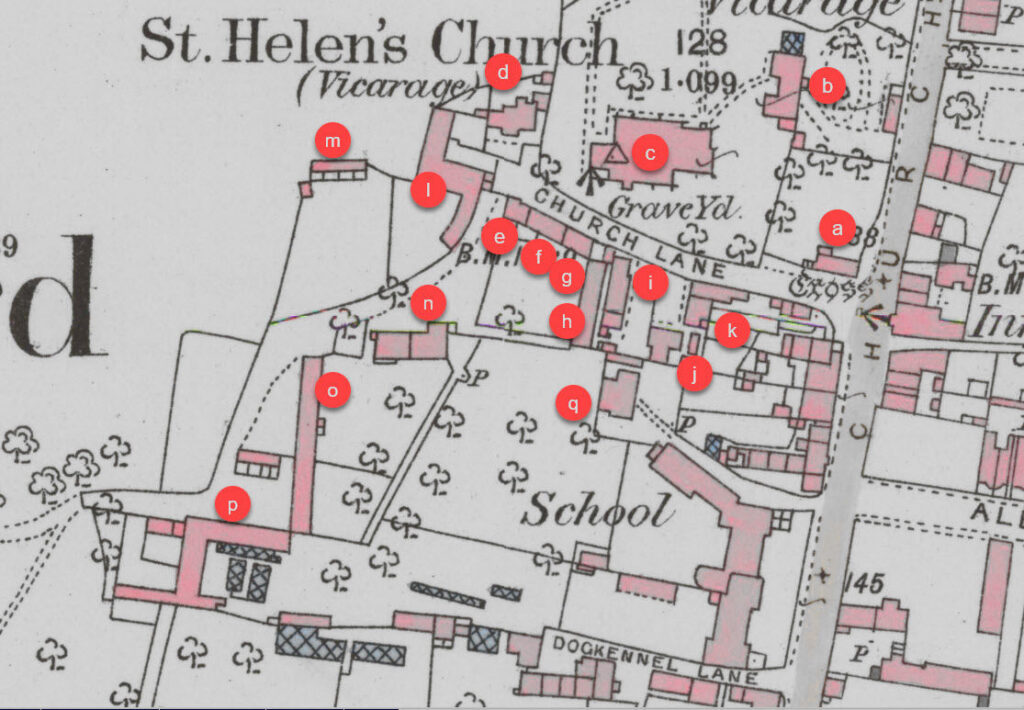
The vicarage and the parish clerk’s cottage – (labelled ‘a’)
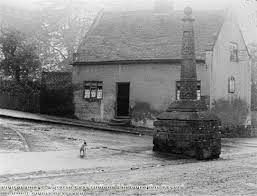
The history of the vicarage can be traced back to, a least, 1714 when the terrier included ‘A vicarage house and barn adjoining thereto and an orchard belonging to the said house.’ This was repeated in 1726 but in 1743 it adds that the vicarage adjoined the churchyard. The house was similarly recorded in 1748 and in 1759, when it was described as ‘a small house,’ and likewise in 1764.
In 1770 a new clergy house seems to have been built. ‘The parsonage house is built of brick and mortar and covered with thatch. Six room in the whole. No outhouses.’ This is two years before the enclosure and would have been shown on the map. In 1777 more detail was added and it is described as
‘A Parsonage House built with Brick and covered with Thatch; containing seven rooms, those below floored with brick, those above with plaster except one which is partly floored with board. The walls of the lower rooms drawn with mortar, the rest have the Rooms below ceiled with Lime, those above open to the thatch. Two outhouses one called a kitchen, the other a coal house, about four yards square; the other about four yards by three; both built with mud and covered with rushes’
This description is repeated in 1786, 1817 and in 1825 when the terrier was signed by Dame Carolyn Warren, presumably in her capacity as one of the ‘residents of standing’ in the village
It seems a reasonable assumption that what we describe as the parish clerk’s cottage, is in fact, the old vicarage. The cottage was on glebe land and described as such when the Rev. Crawford Hillis went to court to eject Martha Daykin in July 1915. [1] The position seems to identify well with the enclosure award map and the terriers, although you might have expected over the years to have seen references to the ‘old vicarage.’
The cottage was occupied in 1841 by William Jones aged 70, school master. He was not the schoolmaster at St. John’s, who was then James Perrin, but probably a teacher employed by the Warrens to teach both the family and to run a school on the estate. (See history of house no. 8 below.). He may have been the parish clerk.
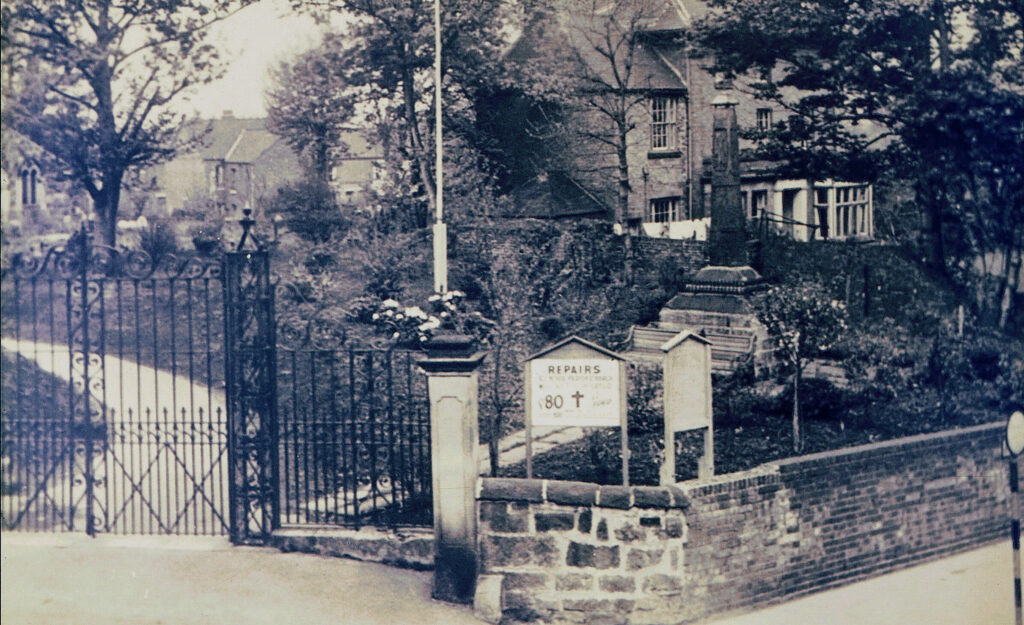
From 1851 to 1915 the house was occupied by the Daykins, starting with 1851 when William Daykin, aged 34, was parish clerk and ending in 1915 when Martha Daykin, aged 59, his daughter, was evicted. She had lived in the cottage all her life and didn’t take kindly to being asked to leave, screwing up the eviction notice when it was served and throwing it on the ground. The church wished to move the gates and extend the churchyard and the vicar, the Rev. Crawford Hillis, tried every possible means to persuade her to move. In the end the church went to court and a formal eviction notice was served. The cottage was presumably demolished shortly after July 1915.
The Victorian Vicarage
The cottages near the tower. Nos. 9 and 10 – (labelled ‘d’)
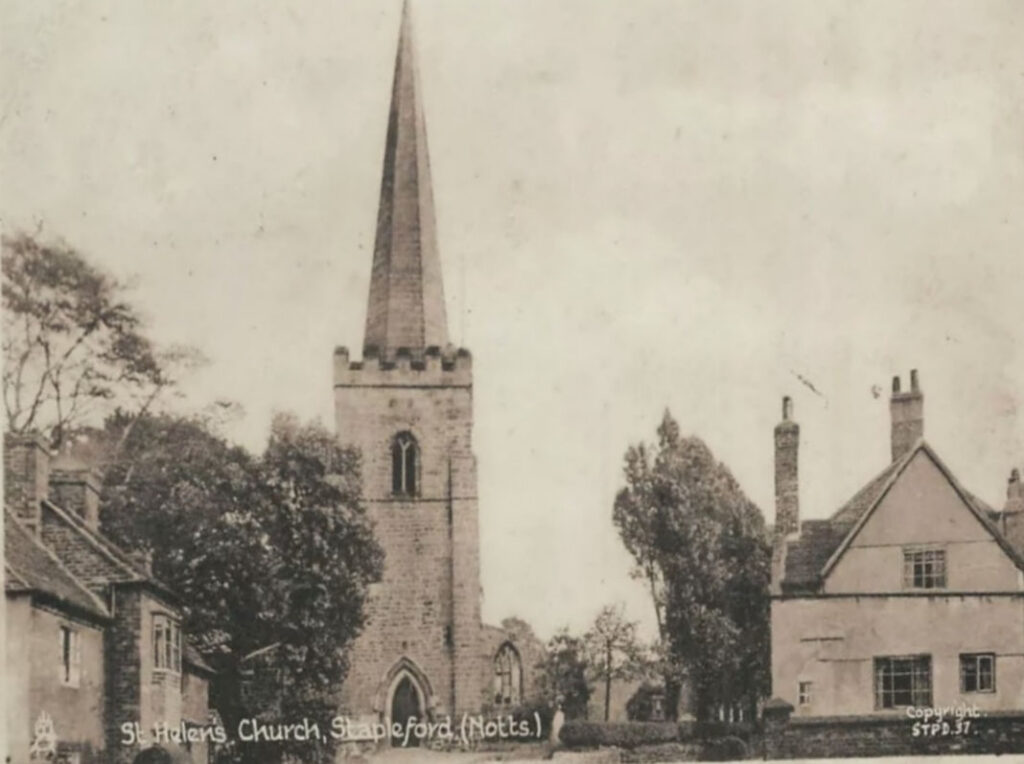
These cottages, although close to the tower, were not on church land but formed part of the Stapleford Hall estate appearing in the details of the 1856 sale. They were No. 40 on the plan ‘House, Parlour, Kitchen and land in front, cart sheds and land in front’ and Ann Saxton was the tenant. They were acquired by the church for £210 in between 1913 and 1923 [9] and demolished as part of the extension of the graveyard at a date unknown, although Ralph Penniston Taylor in his book ‘Views of Old Stapleford’ p.45 includes a photo of them dating from 1933.
The cottages are sometimes linked to Stapleford’s most famous son, Arthur Mee, journalist and author. Arthur’s father was Henry Mee who, in 1871, had moved from Heanor, along with his brother James, to live in Stapleford. At the time of the 1871 census Henry was in lodgings on Nottingham Road, Stapleford, and James was living in one of the cottages near the church tower on Church Lane. Arthur Mee’s biographer, Keith Crawford, states, without quoting his source, that after his marriage in June 1872 to Mary Fletcher Henry moved into a house on Church Street just round the corner from his brother on Church Lane. The 1881 census shows the family living at 7 Pinfold Lane, and that Arthur had been born in 1875, the second child in the family, and younger brother to Annie, who was born in 1873. There is no mention of the place of birth in the biography written by Sir John Hammerton, his long time friend. As far as I can see the first time the cottage was linked to Arthur Mee was by Ralph Penniston Taylor, who was usually factually correct, in his book above mentioned. As can be seen it is difficult to be specific about where Arthur was actually born but, hopefully, more information may be discovered.
| Year | Occupant |
|---|---|
| 1841 | They were probably occupied by Joseph Hodson, the estate boatman. A weir had been constructed near the Cunnery and this created a wide stretch of water near the Hall, complete with a boat house and a small island, for the pleasure of family and visitors. |
| 1851 | Abigail Saxton aged 75 |
| 1861 | Ann Saxton. |
| 1871 | Ann Saxton. The cottage may have been split or added on to so accommodating James Mee, a railway points man. Emma, his wife, and Thomas, their 7m. old son. |
| 1881 | Ann Saxton. Miriam Goulder. JWC refers to them as ‘two small cottages were old Nanny Saxton and Miriam Goulder.’ |
| 1891 | Zachary Gilbert, railway clerk lived in one. The other was uninhabited but may been normally occupied by Miriam Golder as she reappears in 1901.. |
| 1901 | Miriam Goulder. Samuel Jarvis, an iron foundry molder |
| 1911 | Clara Sims, widow. Samuel Jarvis. |
Cottages Nos. 6, 7 and 8 – (labelled ‘e’ ‘f’ ‘g’ ‘h’) .
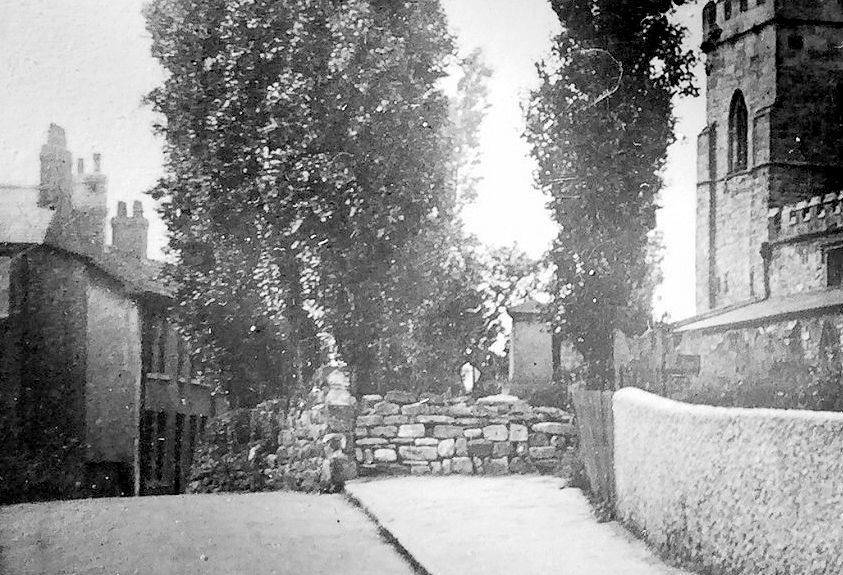
These three cottages are considered together as they were all built on a plot which is shown on the Estate sale details as Lot 8, plot no 42. It is described as ‘House, gardener’s cottage, Hen Roost. Cow shed and school room over’ and ‘New stables, granary, and rooms over.’ It is shown as an L-shaped range of buildings with the base running along Church Lane and the upright situated behind where No.5 now stands. The house was occupied by Robert Atkin.
In the later 1888 map there are three houses here and JWC comments on them,
‘ No.7 ‘Henry Draycott (Bitshie). The Church Sunday School was over this house. This property has now been altered and two nice houses now stands. A Kerry and Mrs Haines lives here.’
These three houses were demolished in January 1970 as part of Stapleford’s slum clearance programme. The site is now occupied by the Stapleford Young People’s Centre.
| Year | 6 | 7 | 8 |
|---|---|---|---|
| 1841 | John Ride | ||
| 1851 | William Potter | ||
| 1861 | Charlotte Atkin | ||
| 1871 | Henry Draycott | ||
| 1881 | Henry Draycott | ||
| 1891 | Jacob Bown | ||
| 1901 | Richard Corden | Mary Prethup | Thomas Jacques |
| 1911 | Oscar Arthur Kerry | Thomas Haynes | John Kirkwood |
Cottages Nos. 1,2,3,4 & 5 – (labelled ‘i”j”k’)
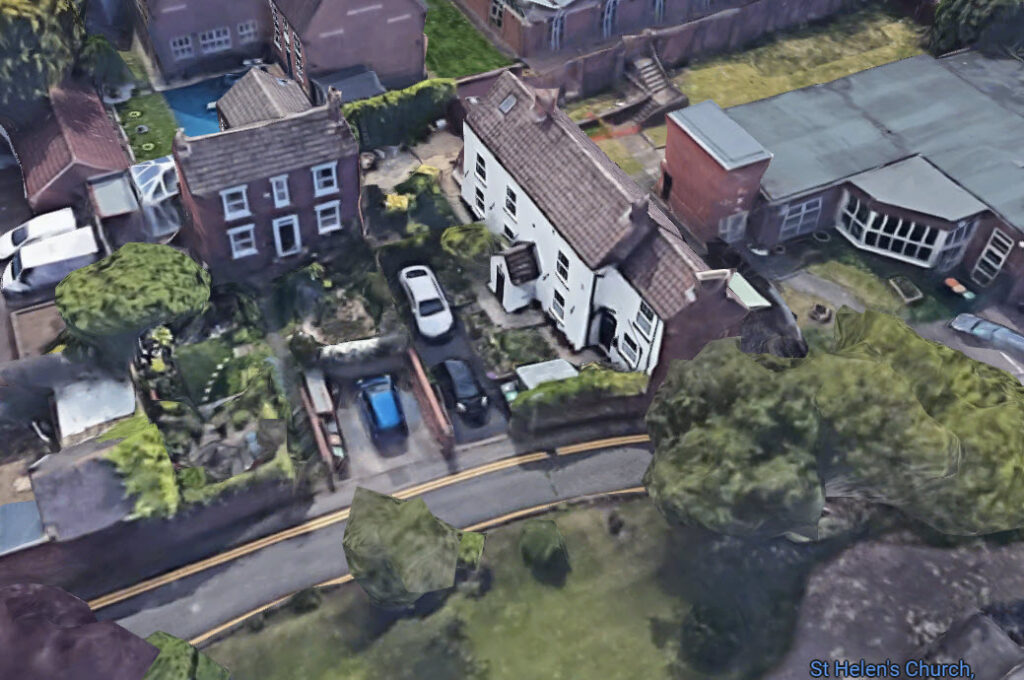
These houses are dealt with together as it seems likely that these were the original nucleus of Church Lane and were built on the small field shown on the Enclosure map just to the south of the church. One interpretation is that five houses were originally built on this plot, Nos, 1 and 2 at right angles to the road, 3 across the top, and 4 and 5 again at right angles to the road. They appear to have been built with their backs close to the boundaries of the plot, hence the lack of gardens, although the enclosure map shows some kind of building in the field adjacent to No.3. The date of construction is difficult to determine but when No.3 was last sold the estate agent told the buyers that it dated from 1823 and was built for a bank manager and that the bank clerks lived at Nos. 4 and 5. This date of 1823 seems to be a reasonable date for the construction of the first cottages on this site given what we know about the history of land holdings after 1772-the date of enclosure, although it would be interesting if any old deeds survive.
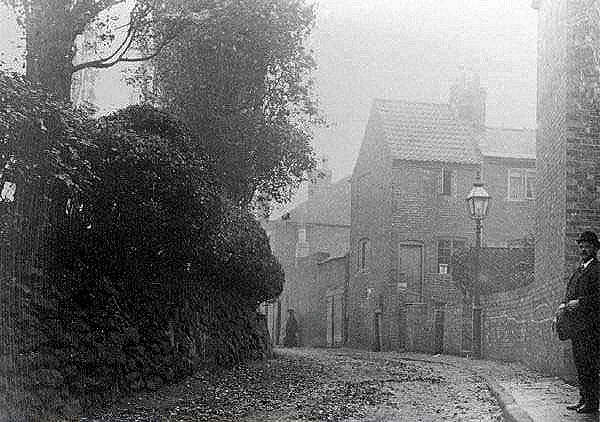
It is not known when numbers 1 and 2 were demolished. They were certainly there in 1911 at the time of the census and No.2 appears in the 1921 census when it was occupied by James Oldershaw. It is likely that they were the original houses built c. 1823. No.1 looks as though it was built later than No.2 and squeezed into the space between No.2 and the road.
The present houses Nos. 4 and 5 likewise probably date from 1823, although considerable alterations have probably taken place over the years. It has been suggested that these houses were at one time the old vicarage but the parish clerk’s cottage seems a more likely candidate.
No.3 is something of a mystery. It has been described as the school house, since it appears to be roughly contemporary with the Board School. However, in the 1911 census George Spencer is shown as living at the school house between No.37 and No.39 Church Street whilst at the same time George Hampson is shown living at No.3 Church Lane making that suggestion not viable.
No.3 is a house of some substance and you wonder why someone who could afford to build a house of that nature would do so in that restricted space. The house has a number of features in common with No. 52 Church Street, (now renumbered to No.49) the house on the corner of Church Street and Church Lane. JWC says that this house was built by Henry Fisher. He was a local painter and decorator who in 1881 was living some distance away on Church Street. In 1891 his widow was living in the house on the corner, Henry having died in 1889. The family continued to live there until at least 1911. The house can be dated, therefore, to between 1881 and 1889. No.3 Church Lane lacks the bay windows and is probably slightly earlier.
The first bank in Stapleford/Sandiacre was the Nottingham Joint Stock Bank and that opened in 1884. One might speculate that the bank manager built the house as an investment to rent but there is nothing to support this theory. Most people lived in houses that they rented and we usually know very little about who owned the houses.
The houses and their inhabitants
As usual it is difficult to allocate a person in the census to a particular house.A possible scenario is as follows:-| Year | 1 and 2 | 3 | 4 and 5 |
|---|---|---|---|
| 1841 | John Barrowcliffe | Lydia Barrowcliffe | John Barrowcliffe Thomas Saxton. (Possibly No.9 and 10) |
| 1851 | William Wootton William Wright Ephraim Tomlinson. Positioned before Lydia Barrowcliffe | Lydia Barrowcliffe Replaced John Barrowcliffe | John Barrowcliffe William Potter. Not the John Barrowcliffe of 1871. Positioned after Lydia Barrowcliffe |
| 1861 | Samuel Shepherd James Ryley William Wootton John Choulerton Barrowcliffe and Brown positioned by reference to 1871. Other names positioned before and after. | John Barrowcliffe. Positioned by reference to 1871 | 4-William Brown 5-Charlotte Atkin. William Brown positioned by reference to 1871 |
| 1871 | Samuel Shepherd. William Tilford Mary Shelton Thomas Gill. Nos. 3, 4 and 5 positioned by reference to 1861 so leaving 4 names for 1 and 2. Where there other houses on Church lane before No.1? | 3-John Barrowcliffe. Positioned by reference to 1881 | 4-William Brown 5-Peter Parks. Positioned by reference to 1881 |
| 1881 | 1-Ann Atkin 2-John Atkin Positioned according to census sequence. | John Barrowcliffe. Positioned according to census sequence | 4-William Brown 5-Peter Parks. Positioned according to census sequence. The Browns appear to have moved house between 1881 and 1891 |
| 1891 | 1 or 2-Samuel Hopewell. Positioned by reference to George Hampson | George Hampson Positioned by reference to 1901 | 4-Joseph Frost/Joseph Winfield. 5-Sarah Brown Sarah Brown positioned by reference to 1901. Joseph Frost and Joseph Winfield positioned between 3 and 5 but it is not clear how they all fit in. |
| 1901 | 1 or 2 George Gerlury. Positioned by reference to George Hampson | George Hampson Positioned by reference to 1911 | 4-John T Simpson 5-Sarah Brown. Sarah Brown positioned by reference to 1911 and John T Simpson entered as No.4 |
| 1911 | 1-Herbert Godfrey 2-James Oldershaw | 3-George Hampson | 4-Mehetabel Parkes 5-George Brown |
Farm buildings, the school house and the old lace factory
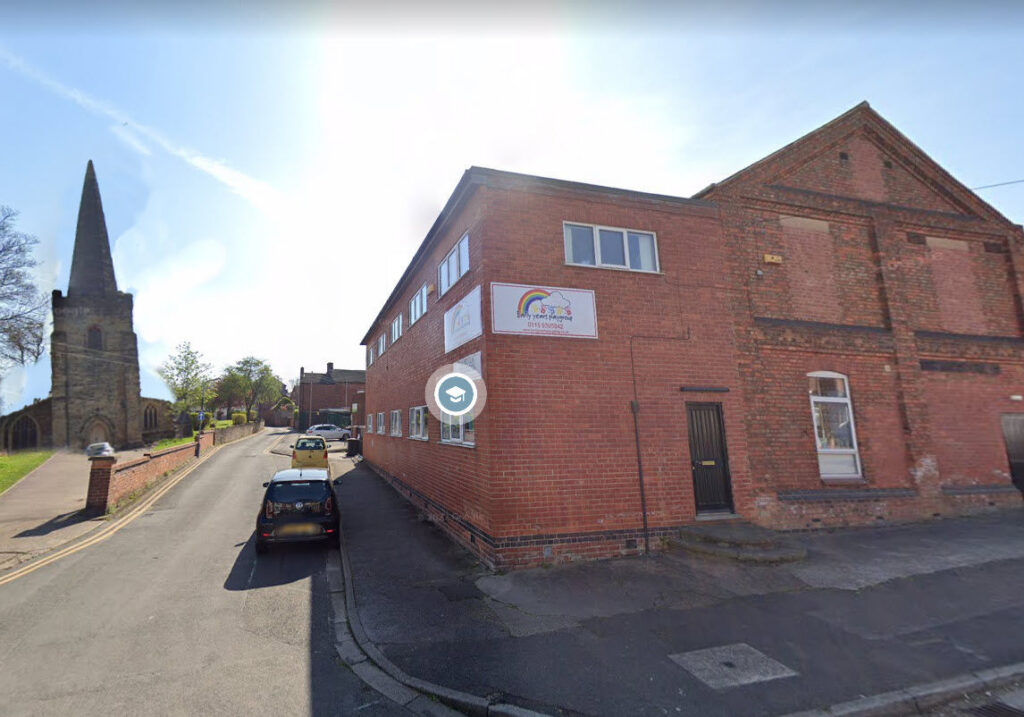
In 1888 Church Lane was shorter than it is now and ended close to where the present churchyard wall changes from stone to brick. The farm buildings were close to the end of the lane and a cart coming down from Church Street would have to turn sharply to the left to go between the last house on Church lane and the line of farm buildings. Today the cart would turn left between the Stapleford Young People's Centre and the old lace factory-now occupied by the Early Years Playgroup. The flat roofed block which extends the factory is built exactly on the footprint of the old farm buildings. Here also would be the footpath that would be used by the inhabitants of the Hall to slip into the church by the back gate.
Farm buildings
Farmhouse, cowsheds, barn, piggeries, foldyard and rickyard-labelled 'l' 'm' and 'n' on the map being Plot 35, part of Lot 6, in the 1856 sale documentation. Stables, coach houses, waggon hovels and other buildings, stable yards etc. and cottage adjoining-labelled 'o' and 'p' on the map being Plot 32 and part of Lot 5 in the 1856 sale documentation.
School House.
The house occupied by the head master of the adjacent school-labelled 'q'
The Old Lace Factory.
The known history of the lace factory is somewhat fragmented. It was built in 1904 [10] as a lace factory by Albert Plackett and Robert Plackett, two cousins. They both lived in Stapleford but were originally from Breaston. Albert was quite young when his parents came from Breaston to live in Stapleford. About 1883 he entered into partnership with Mr. F Jackson and commenced in business as lace manufacturers in Orchard's factory, Long Eaton. In 1902 he entered into partnership with Robert Plackett and they built the Church Lane factory to which they transferred their lace manufacturing business. Albert died in 1923 at the age of 72. 1" [11] Warp lace was made until the 1930s.
During World War II local people say that the factory was used by Rolls Royce for war work and for training apprentices. It was apparently at this time that the flat roof extension was added.
The next known occupant was the Clifton Engineering Co, a company set up by Mr and Mrs Michael Needham and brought to Stapleford in 1954 specialising in light engineering and presswork. [12] In 1958 the building was repurposed by the Needhams as a hardware store. [13] It advertised itself as everything that the home handyman would require under one roof. It was perhaps a concept for which Stapleford was not ready. The idea of providing for the needs of the DIY market was in its infancy-B & Q were still eleven years away-and the business closed down in July 1960. [14] The DIY market was probably not sufficiently robust at that time to wholly support the enterprise and the patronage of the various trades was probably not forthcoming as it required a depth of range which the store did not hold. Nevertheless, it was a very creditable and forward-looking idea not since replicated in Stapleford. The company continued to be the agent of Hill's Portable Buildings and advertised their 1961 selection in February 1961.[15]
The building may have then been occupied by Steeple Press Work Ltd.[16]
The next known occupier was an associate company of Carr Fastener, United Carr Supplies Ltd. This was advertised as a new company in August 1964.[17] Carr Fastener were in an era of expansion and had already taken over the Whiteley Mill complex. As far as can be judged from the advertisements for staff the old lace factory in Church Lane appeared to be used for distribution and dispatch and probably the operation of the sales ledger and finished goods stock holding. In May 1968 it advertised for staff 'due to expansion.' [18] The reason why the operation needed a separate company is a matter of conjecture. Carr Fastener eventually moved this company to Ilkeston sometime between September 1973 and April 1974.[19] [20]
The building was purchased by A E Hubbard Limited and F & C Mason Limited in the 1980s. A E Hubbard was a lace manufacturer/lace convertor formerly of Commerce Square, Nottingham, F & C Mason Limited was a long established Leavers and warp lace maker of Ilkeston, Derbyshire. F & C Mason was the former name of Cluny Lace Co Limited - lace makers, lace manufacturers and convertors of Ilkeston, Derbyshire. The building was used for lace finishing and as warehouse by A E Hubbard. When A E Hubbard went out of business it was retained by Cluny Lace and rented out, first to the Stapleford Centre and then to The Early Years Playgroup, the present (2022) tenants.
The Stapleford Centre was a project set up in 1986 by the Association of Christian Teachers to produce a range of materials to support the teaching of Christianity in the context of school religious education [21] and they purchased the old Wesley Place Methodist Church in Stapleford as a centre for this. In 1997 The Stapleford Centre was formed as a separate company still working closely with the AAT. In 2000 Wesley Place was sold and the company moved its operations to The Old Lace Factory. [22] The company operated in this building until November 2011 when, as a result of reorganisation and remodeling the company relocated to the Parish Hall across the road.
The Early Years Playgroup was formed in 1985 when it was called the Frederick Harrison Playgroup after the school where it met. It was registered as a charity in December 1988. In January 1994 it moved to the nearby Stephenson Junior School and was renamed as the Early Years Playgroup. In 2012 it moved from the Wadsworth Fields School to The Old Lace Factory. [23] It was re-registered by a scheme of the Charity Commission on 2 August 2016.[24]
Lace may no longer be made in Stapleford but, through the Old Lace Factory, a link remains with the last of the traditional lace manufacturers in the country, Cluny Lace.
Footnotes
Click on footnote to return to main text.
- Nottingham Journal 26 July 1915
- Notts. Archives DD/WN/16.
- Notts. Archives DD/WN/19/1-2
- https://reed.dur.ac.uk/xtf/view?docId=ark/32150_s1cv43nw831.xml
- https://www.british-history.ac.uk/vch/middx/vol6/pp107-111
- Daily News 24 Mar 1852
- Morning Advertiser 31 Jan 1852
- Stapleford & Sandiacre News 1Sug 1959 and 4 Sept 1959.
- Stapleford Parish Magazine Jun 1923
- Notts. Archives DC/ST/3/1/1
- Stapleford & Sandiacre News 27 January 1923
- Ibid 14 Feb 1958
- Ibid 12 Sept 1958
- Ibid 17 Jun 1960
- Ibid 10 Feb 1961
- Ibid 1 Dec 1961
- Ibid 14 Aug 1964
- Ibid 24 May 1968
- Ibid 28 Sep 1973
- Ibid 19 April 1974
- T Cooling, Journal of Christian Education, Vol.40, No.1 April 1997
- Companies House 03371977 8 February 2000.
- Report dated 17 Jul 2015 on the Stapleford Community Group website.
- Charity Commission Charity No. 700962