Histories and memories.
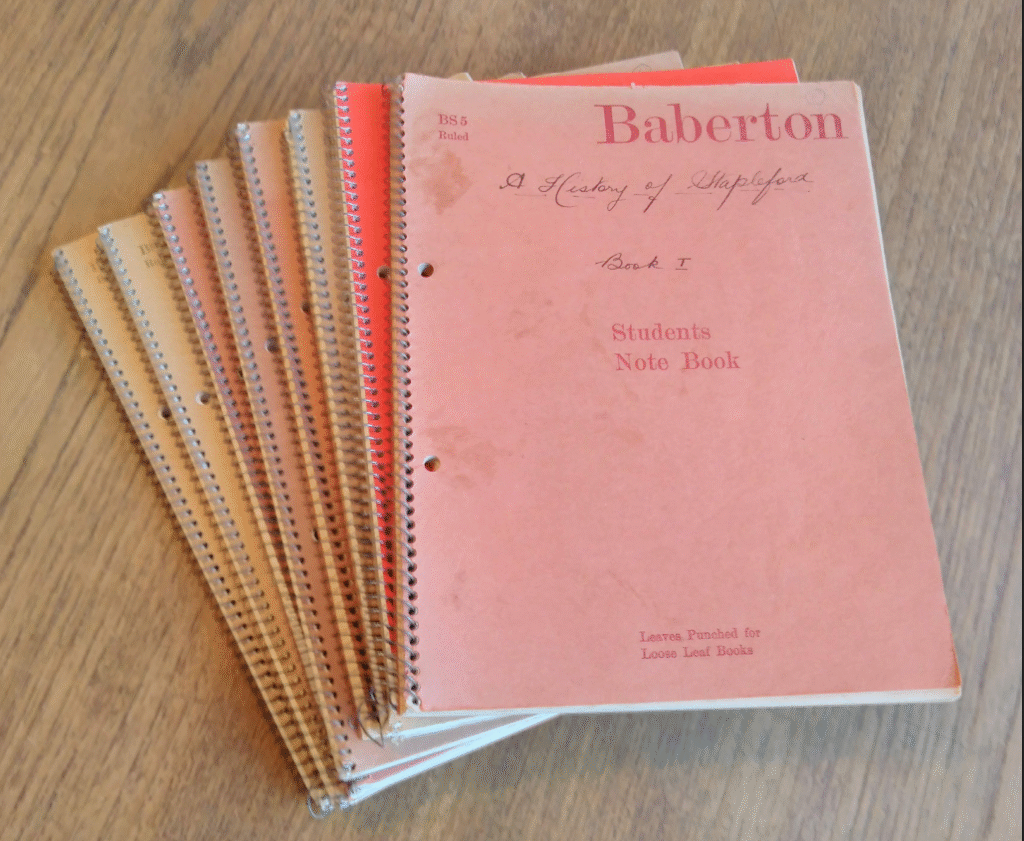
Over the years a number of people have written a history of Stapleford. Some have drawn on documentary sources and formal research, while others have recorded memories of everyday life. Together, their work forms a rich record of how Stapleford has grown and changed over the centuries.
The earliest known account of the town appeared in 1677, when Dr Robert Thoroton included Stapleford in his Antiquities of Nottinghamshire. A much-expanded three-volume edition of the work was produced by John Throsby in 1797, adding further detail and commentary.
More than a century later, in 1888, a small booklet titled Stapleford: Its People and Its History During Eight Hundred Years was published by an anonymous author who identified himself only as an “Octogenarian.” The writer’s identity remains unknown, but the work stands as one of the first attempts to tell the story of the parish in its own right.
In 1906, Robert Mellors produced Notes on the History of Stapleford (Notts.) with Lessons Thereon; Being an Address to the Young Folks of Stapleford. Mellors had originally been invited by George Spencer to write the school’s Christmas letter, but following the illness and death of his wife the piece was delayed and issued separately. His booklet combines local history with moral guidance typical of the period, ending with an invitation to sign a pledge to abstain from alcohol and tobacco until the age of twenty-one, and never to bet more than half a farthing.
Mellors (1835–1931) was a prominent Nottingham figure. A founding member of Nottinghamshire County Council and later an alderman, he was a chartered accountant by profession and played an important part in the city’s business life. He was also a prolific author on local history, topography, and biography, and served as President of the Nottingham Sunday School Union and the United Gospel Mission, later known as the Albert Hall Mission.
Another notable contribution came from John Palmer (1866–1940), whose Notes on Old Stapleford first appeared in the Stapleford and Sandiacre News in 1923 and were later reissued as a pamphlet. Palmer, a member of a long-established Stapleford family, was active in local politics and managed the family joinery business.
These early historians relied mainly on familiar published sources such as Thoroton, the Enclosure Award, and the Transactions of the Thoroton Society. Yet their personal observations and memories often add a valuable human element, giving a sense of how people experienced village life. Copies of their works are preserved in our archives or in local libraries.
In more recent years, the Stapleford Local History Society has helped to preserve the voices of ordinary residents through two books of oral history: Stapleford at the Dawn of the Twentieth Century and Stapleford in World War II. Based on interviews with people who lived through those times, these volumes provide first-hand accounts that bring the past vividly to life. Copies are available to consult in Stapleford Library.
Two other personal recollections deserve mention. In 1926, James William Choulerton recorded his detailed memories of Stapleford life from his birth in 1860 onwards. His twenty-five-page manuscript offers a fascinating portrait of how the village changed over time. James Goodson’s reminiscences cover the 1880s and 1890s; born in 1881, he wrote down his memories in 1969, adding yet another voice to the record of Stapleford’s past.
However, pre-eminent among local historians was Ralph Penniston Taylor. His final work has been transcribed and is reproduced here on this website. Follow the link in the first column to learn more about Ralph and to read his History of Stapleford.