Water supply

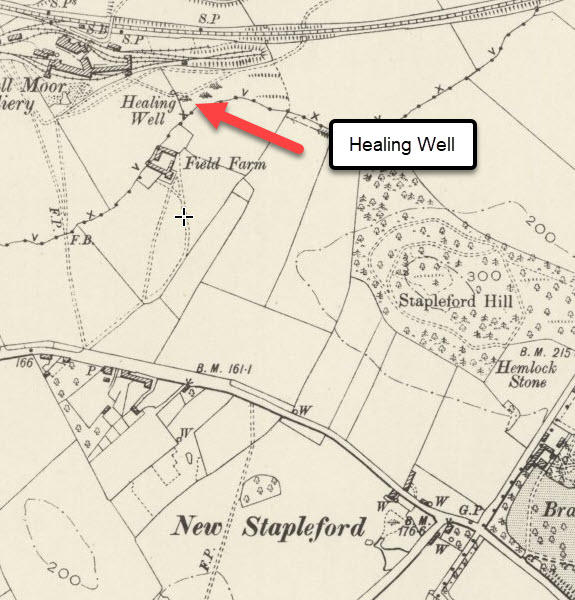
The Healing Well.
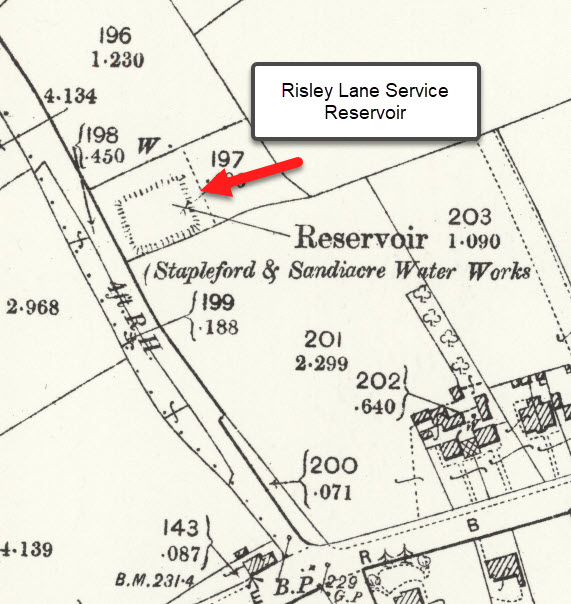
Rushy Lane reservoir.
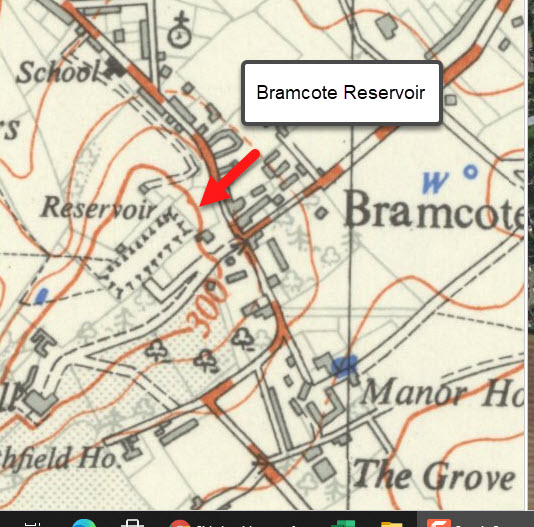
Bramcote Reservoir
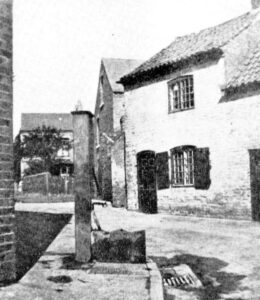
The Parish Pump

Geologically, Stapleford can be divided into three distinct areas. The first comprises the high ground to the south-east of the Nottingham and Derby Road and to the north-east of Ilkeston Road, where the bedrock consists of the Lenton Sandstone Group, formerly known as the Bunter Sandstone. The second area, lying to the west, is the flat alluvial land of the Erewash Valley. The third area, occupying the remaining part of the parish between the Erewash and the high ground, is underlain by the Lower Coal Measures. Wells sunk into the sandstone yield water of satisfactory quality, whereas those drawing from the coal measures or the alluvial plain provide water of inferior quality.

Before the introduction of piped water, people depended either on private wells or on a communal well or pump. The parish pump stood on Nottingham Road at the junction with Church Walk. When the newly formed Parish Council met in 1895 one of its first tasks was to compile a list of parish property on which the parish pump was included.[1]. However, by that time, the pump was no longer in use, having run dry.

Another water source listed was the ‘Healing Well’ used by the people of New Stapleford and situated near Fields Farm, close to the Trowell border. The name was frequently misrecorded by clerks unfamiliar with its etymology, and in this instance, it is recorded as the ‘Ealey Well.’[2] Investigation revealed that the well lay on the far side of the Trowell Sick Dyke, placing it within the parish of Trowell and, therefore, outside the purview of Stapleford Parish Council, even though it was used by Stapleford people.
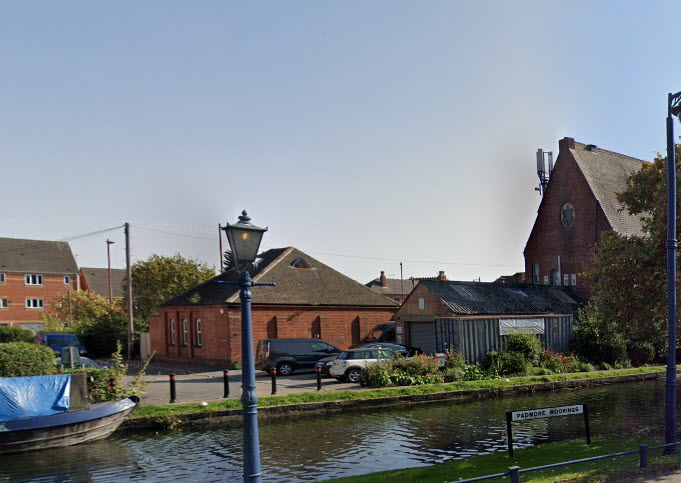
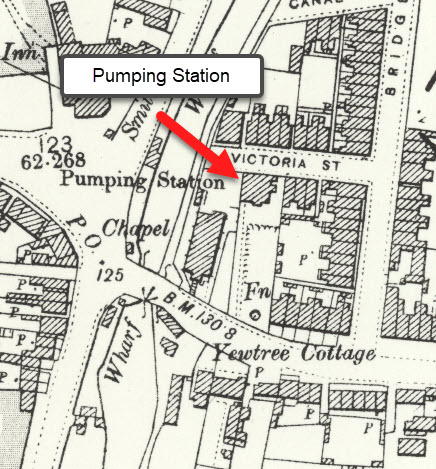
The pumping station on Derby Road, Sandiacre.

Piped water

In 1877, concerns about public health in Stapleford had become so acute that the Local Government Board sent its own inspector, Dr. Richard Thorne, to report on the health of Stapleford. Thorne, an eminent physician who became the Board’s principal medical officer, produced a damning report. He observed that ‘throughout the greater part of Stapleford the water is obviously foul, or is subject to the constant risk of pollution.” Amongst his many recommendations was the provision of an ample and wholesome water supply for the entire village.

The search for a reliable water supply began in the hamlet of Wilshorpe, between Sandiacre and Long Eaton, in June 1889. However, the attempt was abandoned at a depth 371 feet due to the excessive hardness of the water. Further borings were undertaken, and an abundant supply was eventually discovered on Derby Road, Sandiacre, adjacent to the Methodist chapel. Water was pumped at a rate of 240,000 gallons per day without any diminution, and a water works was established on the site.[3]

A service reservoir with a capacity of 70,000 gallons was constructed on Rushy Lane at an elevation of 253 feet above sea level and 11 1/2 miles of main laid to distribute the supply. The reservoir’s height provided sufficient pressure for most of Stapleford, with the exception of the farm at the top of Toton Lane, which stood a few feet higher. To overcome this, the farm installed its own windmill to lift water from a pond at the junction of what is now Cliffe Hill Avenue and Windsor Street, with pipes running beneath what would later become the gardens of houses on Toton Lane.

The business was incorporated as The Stapleford and Sandiacre Water Company in 1891. but progress in installing a piped water supply was slow. The company’s directors reported that “they had considerable prejudice ….. It takes time to induce people to abandon their wells.” The number of houses connected each year was as follows:- 1891-42, 1892-129, 1893-49, 1894-109, 1895-89, 1896-85. The population in 1891 was reported by the directors as 7,000. It is clear from the report that there was little enthusiasm among the community for the adoption of piped water. However, the company’s slow progress was also due to financial constraints as it was evidently undercapitalised and appeared to be relying on current income to fund the extension of the system. Little information is available for the following years, but in 1913 the Parish Council complained that the water was “filthy” and when the proposal was mooted for the local authority to buy the company, the supply was described as both “inadequate and unsatisfactory.” In 1921 the directors indicated their willingness to sell the company, and in 1927 it was jointly purchased by the Shardlow Rural District Council and the Stapleford Rural District Council for £12,063 2s.7d. A new engine, supplied by Messrs. Crossley Bros., was acquired for £280. Efforts were made to increase the water supply, but the obvious area of sandstone in Bramcote lay within Nottingham Corporation’s supply area, and they would have opposed its use. Other potential surces,such as the coal measures, were unsuitable.[4] A request was made to the Derwent Valley Water Board, whose Leicester main passed through the parish of Risley. This led to the construction of a 100,000-gallon reservoir on Hopwell Lane, Risley, built by Fletcher & Co. of Mansfield at a cost of £5,998 9s. 4d. The Derwent Valley Water Board main was tapped on the 10th February 1930 to fill the new reservoir, providing 45,000 gallons of soft Derwent water were bought daily. This was mixed with the local hard water from the Sandiacre Pumping Station.[5] However, the supply was not guaranteed beyond 1935. [6] Ultimately it was decided to seek a supply from the Nottingham Corporation. Following negotiation a purchase price of £8000 was agreed. [7] Notice was given to Shardlow to terminate the agreement.[8] For administrative convenience, the severance of the water main on the boundary was scheduled for 25th December 1931, Quarter Day. However, wiser counsels prevailed, preparations for Christmas dinner were not disrupted and plans were made to cut the main on the 21st. or the 22nd. December instead.[9] There was some dispute regarding the supply to that part of Stapleford west of the Erewash, as Shardlow refused to permit Nottingham to lay a new main down Station Road but this was eventually resolved.[10] Nottingham Corporation had been preparing for the takeover and, in November 1928, petitioned Parliament for permission to construct a service reservoir at Bramcote and to lay a pipeline from its system at the junction of Abbey Bridge and Gregory Street. A connecting main from the reservoir would also need to be laid to link with the Stapleford system at the parish boundary enabling the supply to the town.[11] The supply from the Nottingham system was softer than the Risley reservoir and took “25% of the hard labour out of washday.”