Premier Gas Company Limited.
The Premier Gas Company was Sandiacre and Stapleford’s most renowned company with a national and international reputation.[1] The gas engine is an internal combustion engine powered by coal gas providing a transition between the stationary steam engine and an engine powered by oil based fuels. It is usually a heavy duty engine capable of running continuously at full load. The first successful design was by Nicholaus Otto in 1876 and the UK rights were held by Crossley Brothers Ltd. of Manchester.
Arthur Rollason, John Henry Hamilton and the Beck engine.
Arthur Rollason was born in Exhall, near Coventry, the son of a weaver. He had patented in 1886 a design for a gas engine, called the ‘Beck’ engine, which broke the Otto patent. This was a six stroke engine which utilised the extra two strokes to scavenge any unspent gas from the cylinder. Rollason needed a good draughtsman and was introduced to John Henry Hamilton and together they designed all the details of the engine. This was built for them by Messrs. Black and Hawthorne who in June 1877 reported that ‘they were busily employed constructing Beck gas engines to Mr. Rollason’s patent, of which they were the sole manufacturers.’ [2] A separate company to build the engines, the Beck Gas Engine Co. was formed in January 1887[3] but this did not seem to have been successful.[4]
Hamilton was born in Estersnow, Co. Roscommon in 1858, the son of the Rev. Frederick Hamilton, a minister in the Church of Ireland.[5] He worked for the company for 40 years and on his death in 1932 he was described as ‘one, who more than any other engineer of his time, advanced the development of the gas and oil engine.’[6]
It is not known how the Beck Engine came to be made in Sandiacre but in March 1890 the Midland Engineering Company issued a prospectus offering shares in the company to the public.[7] The company’s purpose was to purchase the sole rights to the manufacture of the Beck Gas Engine and to purchase the freehold property and works known as the Sandiacre Engineering Works. The prospectus gave the name of the vendor as Richard Kendal Evans. The site was valued in 1847 at £14,921 and this probably approximates to the date of purchase. Since that time additions had been made and there was a machine shop in course of erection. The company had over 300 enquiries for engines from home and abroad and since the opening of the London showroom sales had increased to six per week. The company confidently anticipated that with sales of this magnitude a dividend of 20% could be achieved. The company also reported that contracts had been entered into with Rollason and Hamilton. Rollason was to be the manager at a salary of £300 per annum plus 2½% of the profits and Hamilton was to assist him. The contracts had been entered into in July, August and September 1889.
Richard Kendal Evans was from Rotherham. In the 1871 census, at the age of 22, he is described as an iron founder employing 26 men and 13 boys.[8] In 1881 he is a wagon builder[9] and in 1891, as a visitor to Margate, he describes himself as living on own means.[10] It is not known how he came to have contact with Rollason and Hamilton or why he came to Sandiacre, although the prospectus shows that the land was owned by F A Wells, who may have been his brother-in-law. The Midland Engineering Company did not survive as only 700 shares were taken up and the company went into liquidation on the 10th July 1890. The venture seems to have depended on the long-term view that the Beck design was superior or at least equal to the Otto design. The Otto patent expired in 1890 and would soon become freely available and investors probably took the view that the Otto design was the one to be preferred and, in the long term, the one that would prevail.
The “Premier” Gas Engine Company.
Richard Kendal Evans had married Emma Jane Wells in July 1874.[11] She was from a family of 12[12][13] and it was five of her brothers who then bought the business which became known as Wells Brothers.
The five brothers came from the Chesterfield area and were the children of George Wells, a colliery owner. The principal financial partners were Alfred Ernest Wells, managing director of Edgar Allen & Co and George Henry Wells of Eckington Collieries. The names of the remaining three are not known. The brothers took into partnership Rollason and Hamilton.
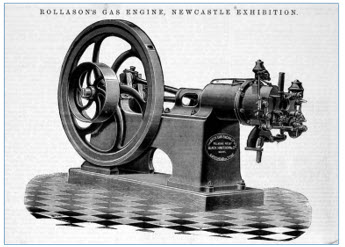
By June 1891 the partnership’s first gas engine was in production and exhibited at the Royal Show at Doncaster.[14], along with 16 other firms,[15] their “Premier” six horse power gas engine.[16] The demand for the company’s products grew and engines were made that were 150, 350 and 600 horsepower and in 1897 the total output was 2,300 I.H.P. The gas engine was particularly suited to powering dynamos for the production of electricity and it was anticipated that demand would continue to increase. Additional plant and working capital was required and in 1898 it was decided that the firm should be incorporated. The “Premier” Gas Engine Company Limited was formed and the business, as at 1 January 1898, was sold to the company for the sum of £38,340 of which £20,000 was taken in fully paid Deferred shares. The company secured the services of Rollason, as managing director, and Hamilton, as chief engineer, for five years. The share capital of the new company was £100,000 and it was hoped that, with the additional facilities, output could be increased to 20,000 I.H.P. The directors of the company were all men of standing within industry and commerce. Pre-eminent was Robert Mond of Brunner Mond and Co., the chemical manufacturing company, one of the four companies that later formed I.C.I. Joining him was Robert Armitage of the Farnley Iron Works, Leeds; William Statham of Handysides in Derby; Alfred E Wells of Edgar Allen of Sheffield, one of the original partners, and Arthur Rollason, one of the managers of Wells Brothers.[17]
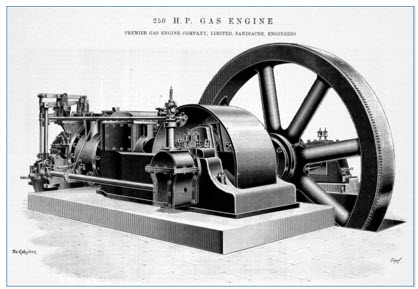
The company continued to expand with a considerable number of overseas customers. It specialised in the larger engines compared to Crossley Brothers, who was its main competitor. In addition to coal gas the engines could also be run on blast furnace gas, suction gas, mond gas and oil based products. In situations where mains gas was not available other methods had to be found to supply gas. One of the gases used was Mond gas, a by-product of Brunner Mond’s ammonia manufacturing process. It was produced using cheap low quality coal when compared to the hard coal required for steam production and this gave a considerable cost advantage enabling the utilisation of stand-alone gas engines when associated with a mond plant. Hamilton and Rollason continued to invent and innovate as the development of engines progressed and registered about 70 patents between them. Hamilton concentrated on the development of engines whereas Rollason tended to range more widely including advances in gas production. At some point before 1911 Hamilton was appointed the managing director[18] and Rollason became the commercial director.[19]
Crossley Brothers (Limited) take over the company.
In 1919 Crossley Brothers(Limited), their main rivals, acquired the whole of the shares of the Premier Gas Company and reported that, in future, they would control that company with the assistance of two former directors, Hamilton and Henry John Gibbons.(1876-1950)[22] There is no mention of Rollason. Gibbons joined Premier Gas in 1898 as cost accountant. He held a number of appointments, introduced a new costing system, was eventually made a director and in 1930, when Hamilton retired, he was appointed as managing director. It was the intention of Crossleys to rationalise engine production with the bigger engines, 300 b.h.p. to 3000 b.h.p. being built in Sandiacre and the smaller ones in Openshaw. In 1920 extensions were in hand which would treble the output of the Sandiacre works.[23] In January 1935 the company’s name was changed to Crossley-Premier Engines Limited and later that year there was a capital restructure and 150,000 5½% £1 Preference shares were sold to the public. The prospectus for these shares gave details about the company which had not previously been made public. The net profit before tax in the years to 30th April 1933, 1934 and 1935 was £25,214, £15,654 and £37,659 respectively and estimated to be £42,428 for 1936. The company’s fixed asset were valued at £168,000 and its current assets £148,000, a total of £316,000. Liabilities were £41,000, making the company’s book value £275,000.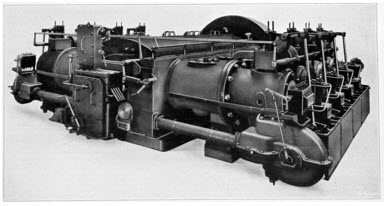
In 1937 two oil engines of 2,100 b.h.p. were supplied to the Jerusalem Electric Light & Power Co. and the gold mining industry had purchased a total of 150,000 horse power from the company in the preceding few years. A modern block of offices had been recently erected.[24]
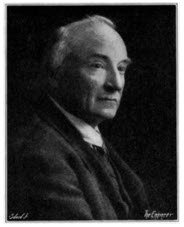
The fourteen years from 1933 to 1946 saw average annual profits of c£44,000[27] and the company maintained a steady dividend of over 10% on its ordinary shares. In 1945, as part of its plans for post war recovery, Crossley Brothers Limited raised capital through a share issue of 950,000 cumulative preference and deferred ordinary shares. At Sandiacre it was proposed to extend the works to double its present productions and to transfer some of the work from Openshaw to free up production space. Orders were in hand to sufficiently occupy production capacity for the following two years, of which 96% were for export.[28]
In 1948 H J Gibbons, who had retired in 1946, delivered the Henry Ackroyd Stuart lecture at Nottingham University and chose as his subject his old colleague, John Henry Hamilton.[29]
In 1957 William George Pinder was appointed managing director. He had been with the company since 1912. He was born in Sandiacre, the son of Harold Robinson Pinder, an iron turner at the works.[30] He was J H Hamilton’s nephew, Hamilton having lodged with Pinder’s uncle and married his aunt Edith, who was living with her brother. He became Chief Engineer in September 1955 and managing director in 1957.[31]
Competition and decline.
In 1956 the group saw a slight decline in profits reflecting increasingly competitive conditions in foreign markets, where the group had to fight hard to maintain its position.[32] Costs had risen appreciably but selling prices had to be kept down and margins had suffered. This trend continued in 1957 when margins and profits were also lower.[33] One of the company’s main competitors was SEMT-a French company who specialised in the design and construction of diesel engines. Their designs originated in work done by Gustav Pielstick on engines to power submarines for the German navy. They were very compact with a high power to weight ratio and had been continuously developed since 1946 and were now much ahead of the Crossley designs. In February 1962 agreement was reached with SEMT for the manufacture under licence of the ‘Pielstick’ range of diesel engines.[34] A week later the firm announced that its tender for the supply of two engines valued at £240,000 to the Electricity Corporation of Nigeria had been accepted. It is not clear whether work had already been done in preparation for the new engine or whether it reflected a confidence in their ability to retool in time to deliver the engines on contract.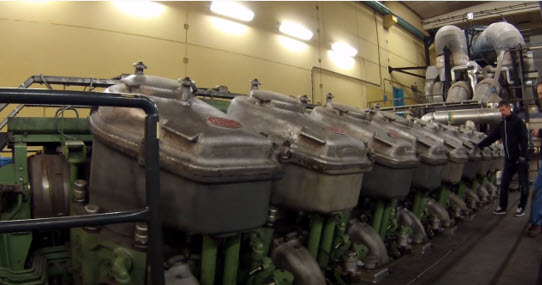
The group was still facing problems and in 1965 it announced that the work done in the Sandiacre factory was to be transferred to the Openshaw factory of its parent company and that plant concerned with the making and testing of the Pielstck engines would be moved in order that the complete manufacture would take place under one roof. The factory in Sandiacre was sold to Peter Brotherhood Limited of Peterborough, for £550,000.[35] Peter Brotherhood Limited were an engineering firm and hoped to employ most of the ex-workers of Crossley-Premier.
In spite of the consolidation the Crossley group quickly went into the hands of the receivers and a reorganisation took place which sold the undertaking and assets to the subsidiaries. It is not possible to say precisely what was the make up of the company and how it related to the old Sandiacre company. In November 1966 the company, still called Crossley-Premier Engines Limited, was bought by Bellis & Morcom for £202,000. The company had made a loss of £37,000 in 1964-65 and, moreover, had a bank overdraft of £1.06m repayable in instalments over 5 years, but Bellis rejected the assertion that it had paid a high price.[36] In March 1967 the company received an order for six Pielstick engines worth £750,000 and claimed it as a tangible sign of its ability to revitalise the company.[37] In November 1968 Bellis & Morcom and W H Allen Sons merged to form the Amalgamated Power Engineering Group.[38] In August 1981 Amalgamated Power Engineering Group was taken over by Northern Engineering Industries based in Newcastle.[39] In April 1989 Rolls-Royce plc. made an offer to acquire the issued share capital of Northern that it did not already own. This was declared unconditional on 15 May 1989 and Rolls-Royce plc became the ultimate holding company.[40] Rolls-Royce sold Bellis & Morcom to Harmworthy Engineering Ltd., part of the Powell Duffryn Group[41] but the sale did not include the old Crossley-Premier Engines Limited now called A.P.E.-Crossley Limited.[42]
The original company, no.56502, remained as a subsidiary of Rolls-Royce plc. The company was dissolved on the 3 Nov. 2006[43] but this was revoked in March 2009 on the application of a creditor and restored to the register on 31 March 2009.[44] It was finally dissolved on the 17th May 2022.
Footnotes
Click on footnote to return to main text
- Unless otherwise stated, the information in this history is taken from Graces Guide, the obituary of H J Hamilton found in The Engineer, 4 Mar. 1932 or the Herbert Ackroyd Stuart Lecture given by H.J.Gibbons in 1948.
- Shields Daily Gazette, 7 June 1887.
- Morning Post, 8 Jan. 1887.
- London Gazette, 12 Dec. 1893, 7276.
- Griffith Richard, General Valuation of Rateable Property in Ireland, Estersnow.
- The Engineer, 4 Mar. 1932.
- Yorkshire Post, 8 March 1890.
- TNA R10/4702, 113.
- TNA R11/4671, 100
- TNA R12/729, 37.
- Diocese of Derby, Parish Register, Eckington 1874.
- TNA RG9/2534, 76.
- TNA RG10/3618, 35.
- The Engineer, 26 June 1891.
- The Engineer, 26 June 1891.
- Derby Daily Telegraph, 22 June 1891.
- Derbyshire Advertiser & Journal, 25 March 1898.
- TNA R/14/20840, 7.
- TNA R14/20828, 275.
- Folkestone Express, 26 November 1904.
- Nottingham Journal , 30 Oct. 1906.
- Yorkshire Post, 23 Sep. 1919.
- The Times, 26 Feb. 1920.
- Long Eaton Advertiser, 9 July 1927.
- Grant of Probate,1932, Hamilton John Henry.
- Grant of Probate, 1922, Rollason Arthur.
- The Times, 18 Dec. 1946.
- The Times , 18 Dec. 1946.
- Graces’ Guide, Henry John Gibbons.
- TN RG14/20846, 258.
- Long Eaton Advertiser, 30 Nov. 1962.
- Birningham Daily Post, 26 Sept. 1956.
- Birmingham Daily Post, 25 Sept.1957.
- Long Eaton Advertiser, 2 March 1962
- Long Eaton Advertiser, 19 Mar. 1971.
- Birmingham Daily Post, 22 Nov. 1966.
- Birmingham Daily Post, 8 Mar. 1967,
- Birmingham Daily Post, 5 November 1968.
- The Times, 15 Aug. 1981.
- Companies House, No..1305027, Accounts for the year to 31st December 1989.
- The Times, 2 June 1995.
- Companies House No. 56502, Change of Name 5 Sept.1977.
- Companies House No. 56502, Dissolution 3 Aug.2006.
- Companies House No. 56502, Restoration 3 Apr. 2009.